When the Boundaries Between Worlds Disappeared
For centuries, people across the forests, rivers, and villages of Poland believed that there was one extraordinary night unlike any other. A night when ancient spirits wandered freely through the woods, medicinal herbs gained supernatural powers, mysterious lights danced above marshes, and the invisible boundary separating the human world from the realm of magic became almost transparent.
This was Kupala Night, known in Polish as Noc Kupały—one of the oldest and most fascinating celebrations inherited from the ancient Slavs. Long before Christianity arrived in Poland, communities gathered during the summer solstice to honor nature, fire, water, fertility, and the life-giving power of the sun.
Yet alongside joyful festivities, another world awakened.
According to centuries-old legends, this was also the night when witches prepared powerful potions beneath the moonlight, herbalists searched for plants blessed with magical strength, and supernatural beings emerged from rivers, forests, and abandoned fields.
See also The Role of Traditional Clothing in Ceremonial Practices
Were these stories merely folklore?
Or did they preserve fragments of beliefs once held by millions of people throughout the Slavic world?
To understand why Kupala Night became surrounded by tales of witches and magic, we must first travel back more than a thousand years—into a landscape where every river possessed a spirit, every forest concealed ancient secrets, and nature itself was considered alive.
A World Filled With Spirits
Modern people often separate reality from fantasy.
See also The Role of Traditional Clothing in Rituals and Ceremonies Across the Globe
Ancient Slavs did not.
To them, every part of nature contained an unseen presence.
The forest was not simply a collection of trees.
It was home to invisible guardians.
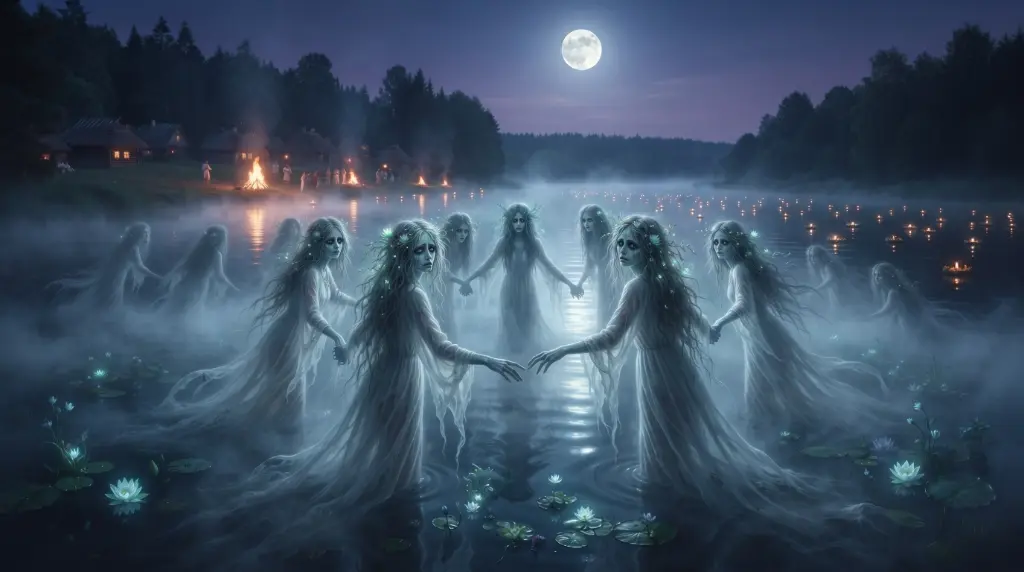
Rivers were believed to shelter mysterious water spirits.
Fields belonged to supernatural protectors.
Even household fires possessed sacred meaning.
Life itself was understood as a delicate balance between the visible and invisible worlds.
This belief system shaped every aspect of daily life.
People offered gifts to rivers before fishing.
Farmers prayed to nature before planting crops.
Travelers avoided entering forests after sunset.
Children learned from an early age that not every sound heard at night belonged to an animal.
Many belonged to beings that humans should neither disturb nor provoke.
Kupala Night was believed to be the one evening each year when these hidden forces became especially active.
Why the Summer Solstice Was Considered Magical
The summer solstice is the longest day of the year.
For ancient agricultural societies, it marked the height of life itself.
The crops were growing.
Animals had given birth.
Forests were lush.
Rivers flowed with abundance.
The sun appeared almost invincible.
Because life reached its greatest strength, people believed magical energy reached its peak as well.
This extraordinary balance created a brief window during which:
- Plants became powerful medicines.
- Water purified both body and spirit.
- Fire destroyed evil influences.
- Dreams carried prophetic meaning.
- Love spells became stronger.
- Fortune could change forever.
For this reason, villagers remained awake throughout the entire night.
Sleeping through Kupala Night meant missing the year’s greatest opportunity for blessings, love, health, and prosperity.
Were There Really Polish Witches?
This question has fascinated historians for generations.
The answer depends on what we mean by the word witch.
Modern popular culture often imagines witches wearing black hats, flying on broomsticks, casting dramatic spells, and living alone in haunted forests.
The women described in traditional Polish folklore were very different.
Many were respected members of their communities.
Some served as healers.
Others acted as midwives.
Some possessed extensive knowledge of medicinal herbs passed from one generation to another.
They understood:
- healing plants,
- poisonous mushrooms,
- childbirth,
- weather patterns,
- animal behavior,
- natural remedies.
Because they possessed knowledge that others did not fully understand, they gradually became associated with magic.
In Polish folklore, these women were often called wiedźmy.
The word comes from the old Slavic root wiedzieć, meaning to know.
Originally, a wiedźma was not necessarily evil.
She was simply a woman who possessed secret knowledge.
Only centuries later, influenced by medieval witch hunts throughout Europe, did the image become darker.
The Wise Women of the Forest
Many villages relied on elderly women who understood the healing properties of local plants.
These herbalists could identify dozens, sometimes hundreds, of useful species growing naturally in meadows and forests.
They knew which flowers eased fever.
Which roots relieved pain.
Which leaves stopped bleeding.
Which herbs protected livestock.
Their knowledge appeared almost miraculous.
When a child recovered after drinking an herbal infusion, villagers praised the healer.
When someone died despite treatment, however, fear often replaced gratitude.
Over time, admiration and suspicion became inseparable.
People respected these women.
But they also feared them.
Especially during Kupala Night.
Why Herbs Were Collected Only on This Night
One of the oldest beliefs surrounding Kupala Night involved medicinal plants.
Ancient Slavs believed that herbs gathered during the summer solstice possessed extraordinary power unavailable at any other time of year.
Some traditions required collecting plants before sunrise.
Others insisted they be gathered beneath moonlight.
Silence was often essential.
Speaking aloud could weaken a plant’s magical strength.
Popular herbs included:
- St. John’s Wort
- Mugwort
- Yarrow
- Chamomile
- Wormwood
- Thyme
- Sage
These plants were dried inside homes for protection throughout the year.
Some were burned during storms.
Others were placed beneath pillows to encourage prophetic dreams.
Many were woven into flower wreaths carried during Kupala Night celebrations.
The line separating medicine from magic barely existed.
Healing the body and protecting the soul were considered parts of the same practice.
Bonfires That Defeated Darkness
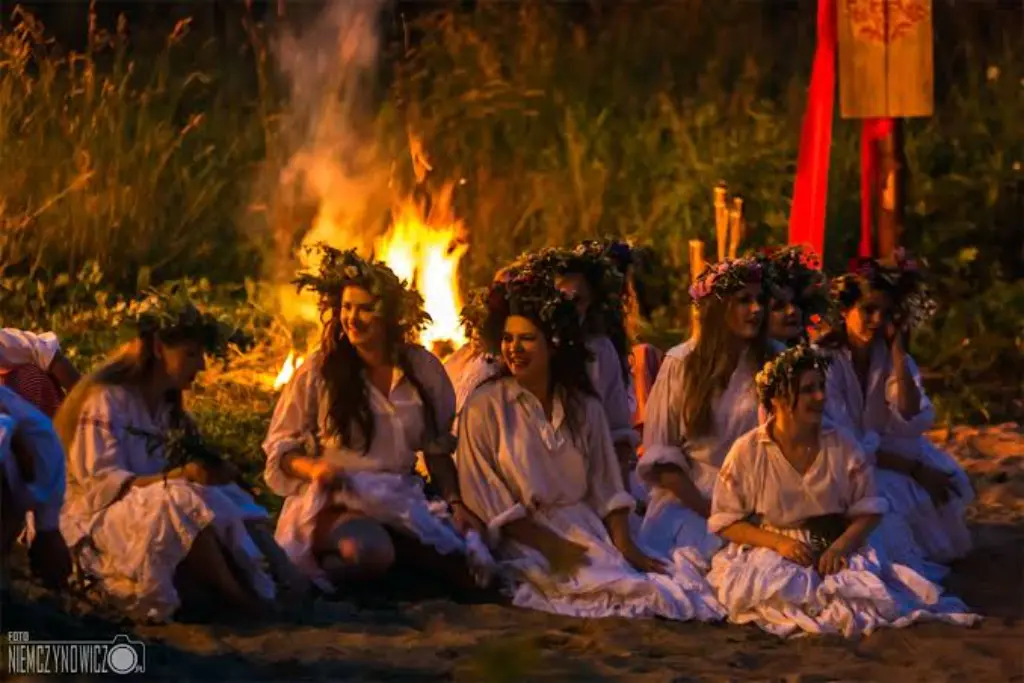
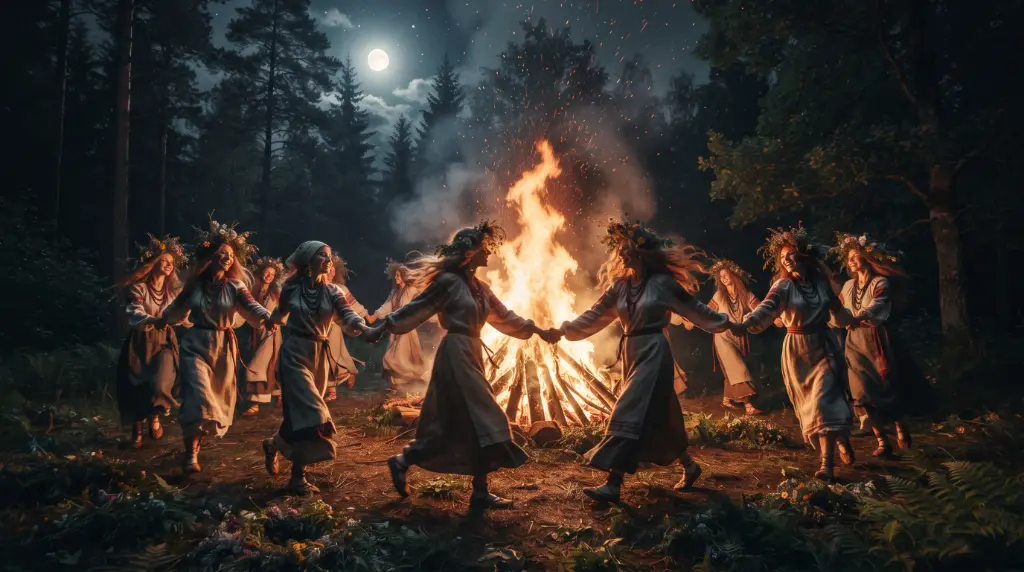
As sunset faded, villages prepared for the most spectacular moment of the celebration.
Enormous bonfires were built using carefully selected wood.
The fires represented much more than celebration.
They symbolized:
- the victory of light over darkness,
- purification,
- fertility,
- protection,
- the strength of the summer sun.
People believed that evil spirits avoided fire.
Smoke rising toward the heavens carried prayers to unseen powers.
Young couples jumped over the flames hand in hand.
If they landed together without letting go, tradition promised a happy and lasting marriage.
The higher the leap, the greater the fortune believed to await them in the coming year.
The fires burned until dawn, transforming hillsides into glowing beacons visible from miles away.
Fire as Protection Against Witches
Ironically, while modern legends often describe Kupala Night as a gathering of witches, ancient villagers believed the festival’s bonfires actually protected people from harmful magic.
Throughout the Slavic world, fire was considered one of the purest forces in nature.
It could not lie.
It could not be corrupted.
It destroyed disease, cleansed homes, and frightened away wandering spirits.
Families often carried burning branches from the communal bonfire back to their farms. A small piece of sacred fire placed inside the household hearth was believed to protect the family throughout the coming year.
Some farmers walked around their fields carrying burning torches.
Others guided their livestock through the smoke.
These rituals were thought to shield crops and animals from illness, storms, and supernatural misfortune.
Rather than welcoming witches, many communities believed they were keeping dangerous forces away.
The Rivers That Revealed Destiny
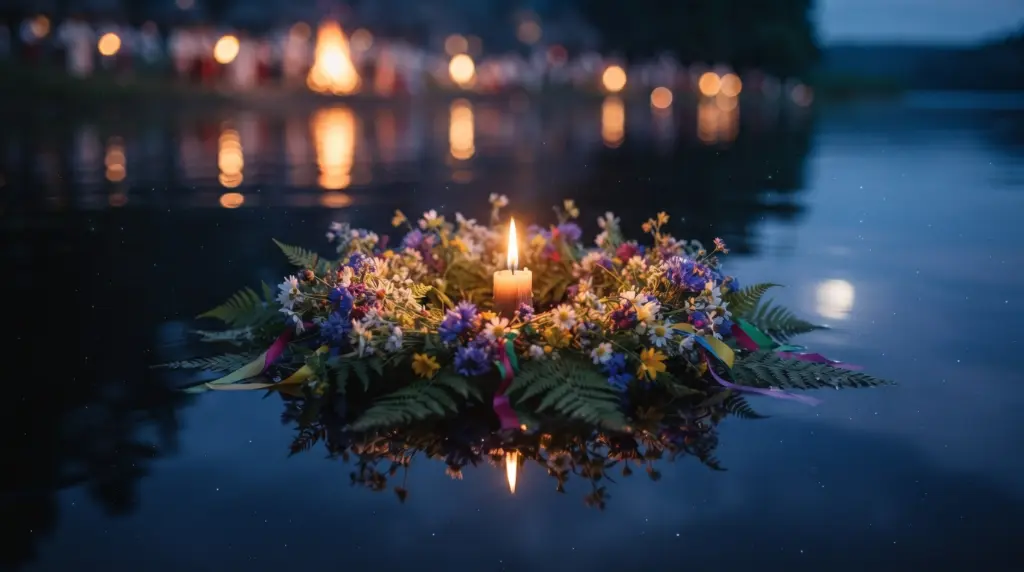
If fire ruled the hills, water ruled the valleys.
Rivers became the center of countless rituals once darkness settled across the countryside.
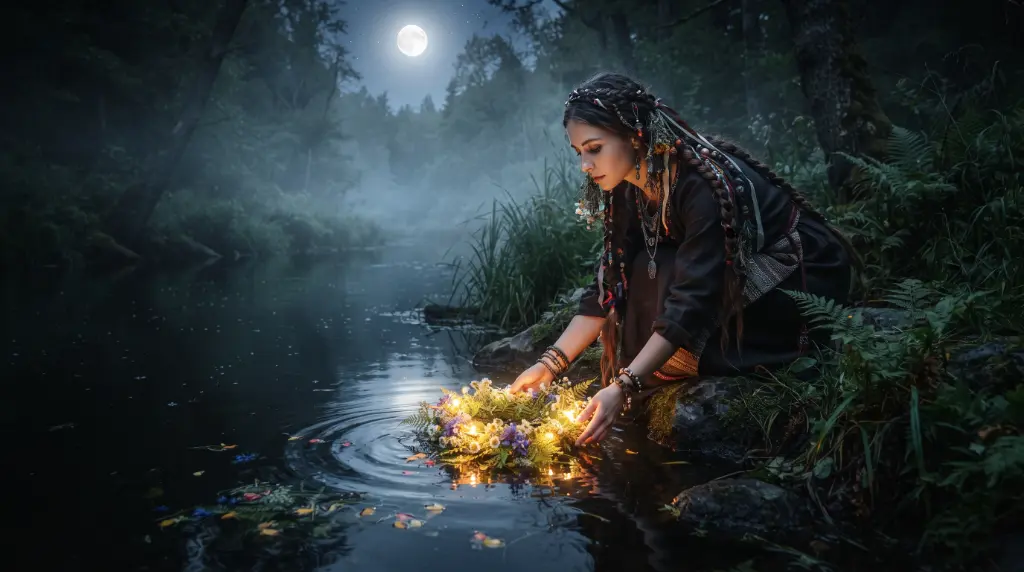
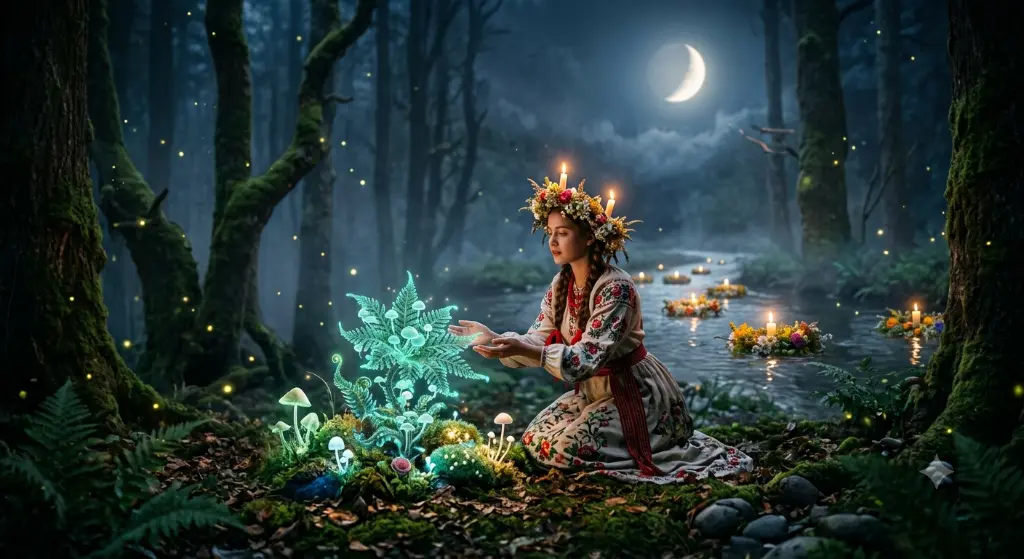
Young unmarried women spent the afternoon weaving elaborate flower wreaths from wildflowers, grasses, herbs, and oak leaves.
Small candles were carefully placed in the center.
As midnight approached, the glowing wreaths were released into rivers and lakes.
The journey of each wreath was believed to reveal its owner’s future.
If the wreath floated smoothly downstream, good fortune was expected.
If a young man retrieved it from the water, romance might soon follow.
If two wreaths drifted together, people whispered that a future marriage had already been chosen by fate.
But not every omen was hopeful.
A wreath spinning endlessly in circles suggested uncertainty.
One trapped among reeds warned that obstacles lay ahead.
If the candle quickly went out or the wreath sank beneath the surface, many feared heartbreak or disappointment.
Although today’s celebrations treat the custom as playful folklore, generations of young people once watched their floating wreaths with genuine anticipation.
The Legendary Fern Flower
No legend captures the mystery of Kupala Night more than the tale of the Fern Flower.
According to Slavic folklore, somewhere deep within the forest, an ordinary fern performs an impossible miracle.
For only a single heartbeat each year—during the darkest moment of Kupala Night—it blossoms.
Anyone fortunate enough to find this glowing flower receives extraordinary gifts.
Stories describe different rewards:
- limitless wealth,
- perfect happiness,
- wisdom beyond ordinary people,
- the ability to understand animals,
- hidden treasures buried beneath the earth,
- protection from evil spirits.
The legend contains a fascinating contradiction.
Ferns never produce flowers.
Modern science explains that they reproduce through spores rather than blossoms.
Ancient storytellers likely understood this mystery differently.
Because the flower could never truly exist, the search itself became symbolic.
The Fern Flower represented humanity’s endless pursuit of dreams that seem impossible.
Many young couples entered forests together during Kupala Night, supposedly searching for the mythical blossom.
Parents smiled knowingly.
The legendary flower often became an excuse for lovers to spend time alone beneath the stars.
The Spirits of the Forest
The forests surrounding ancient villages were places of wonder—but also fear.
During Kupala Night, many believed the woodland spirits became especially active.
One of the best-known figures was Leshy, the guardian of the forest.
Descriptions varied across regions.
Sometimes he appeared as an old man covered in moss.
Other stories described a towering giant whose beard resembled tangled roots.
He protected wild animals and punished hunters who showed disrespect toward nature.
Travelers who ignored forest customs might suddenly lose their sense of direction.
Even familiar paths seemed to disappear.
Legends claimed this was Leshy leading careless visitors deeper into the wilderness until they admitted their arrogance.
Respect for nature, therefore, became both a spiritual belief and a practical survival lesson.
Beautiful but Dangerous: The Rusałka
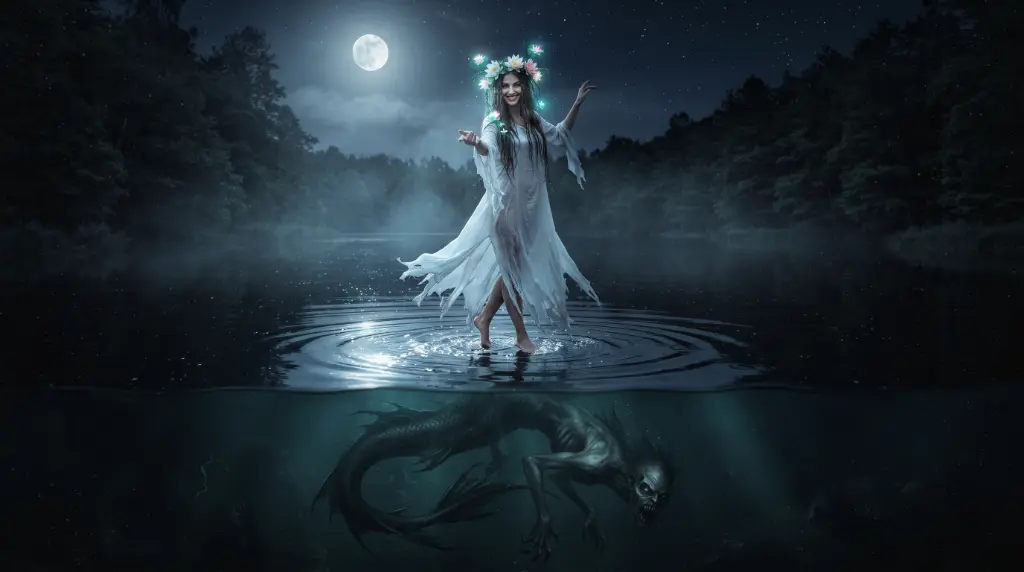
Among all Slavic supernatural beings, few inspired more fascination than the Rusałka.
Often compared to a mermaid, she was believed to inhabit rivers, lakes, and marshes.
Descriptions differed from village to village.
Some imagined her as breathtakingly beautiful.
Others portrayed her with long green hair and eyes that reflected moonlight.
On Kupala Night, people believed Rusałki emerged from the water to dance in meadows or sing beside rivers.
Their voices were said to be irresistible.
Anyone who followed the enchanting songs risked disappearing forever.
Some legends claimed the spirits merely lured travelers into deep water.
Others suggested they represented restless souls unable to find peace.
Parents warned children never to approach rivers alone during Kupala Night.
Behind the frightening stories lay an important lesson about respecting powerful natural waters.
The Strzyga: Poland’s Most Feared Night Creature
Long before vampire stories became popular in Western Europe, Poland possessed its own terrifying nocturnal being.
The Strzyga.

Unlike elegant fictional vampires, the Strzyga belonged to ancient Slavic folklore.
She was believed to roam at night searching for unsuspecting victims.
Legends claimed some people were born with two souls.
After death, one soul departed peacefully while the other remained trapped inside the body.
This second soul transformed the deceased into a Strzyga.
Villagers feared encounters with these creatures, especially during nights when supernatural forces were believed strongest.
Although historians recognize these tales as folklore, they reveal how medieval communities attempted to explain illness, sudden death, and unexplained tragedies.
Witches, Dreams, and Midnight Visions
Kupala Night was also associated with prophetic dreams.
Many people believed that sleeping after placing sacred herbs beneath a pillow would reveal future events.
Young women often hoped to dream about their future husbands.
Others sought guidance about difficult decisions.
Certain plants were considered especially powerful.
Mugwort, St. John’s Wort, and yarrow frequently appeared in traditional dream rituals.
Some families burned aromatic herbs before bedtime.
The fragrant smoke was believed to invite positive spirits while driving away nightmares.
Even today, echoes of these customs survive in rural folklore throughout Poland.
Love Magic Under the Summer Moon
Few nights carried stronger associations with romance than Kupala Night.
The celebration naturally brought young people together through dancing, singing, and communal festivities.
But folklore added another layer.
Many believed love itself became more powerful during the solstice.
Young women braided herbs into wreaths believed to attract faithful partners.
Young men carved symbols into pieces of wood before tossing them into bonfires while silently making wishes.
Some couples secretly exchanged flowers gathered before dawn.
Others tied ribbons around ancient oak trees, asking nature to bless their future together.
Whether these rituals truly possessed magical power mattered less than the hope they inspired.
For generations, Kupala Night became one of the year’s happiest occasions for courtship, friendship, and new beginnings.
Magic Hidden in Everyday Life
Perhaps the most fascinating aspect of Polish folklore is that magic rarely appeared as spectacular spells or dramatic curses.
Instead, it quietly existed within everyday activities.
Lighting a candle.
Collecting herbs.
Crossing a river.
Walking through a forest.
Watching birds.
Listening to the wind.
For ancient Slavs, every action carried symbolic meaning.
Nature was not separate from humanity.
It was humanity’s oldest companion.
This worldview explains why Kupala Night continues to captivate modern audiences.
Its stories remind us of a time when the ordinary world still felt mysterious.
Christianity and the Transformation of Kupala Night
As Christianity spread across Poland between the 10th and 12th centuries, many ancient Slavic traditions faced an uncertain future.
The Church discouraged rituals connected with pagan gods, sacred groves, and seasonal ceremonies. Yet Kupala Night proved impossible to erase completely.
Rather than disappearing, the celebration gradually evolved.
Many customs became associated with St. John’s Eve (Noc Świętojańska), celebrated on the night of June 23–24. Bonfires remained, flower wreaths continued to float along rivers, and communities still gathered outdoors during the year’s shortest night.
The meanings, however, slowly changed.
What had once honored the sun, nature, and ancient Slavic deities became connected with Christian symbolism, blessings, and local parish celebrations.
This blending of traditions created one of Poland’s most fascinating examples of cultural continuity.
Even today, many people celebrating Kupala Night may not realize that some customs are over a thousand years old.
The Witch Hunts That Changed Everything
For centuries, the wiedźma—the wise woman—had occupied a respected, if sometimes mysterious, place within village life.
But between the 15th and 17th centuries, Europe experienced one of its darkest periods: the witch hunts.
Ideas spreading from Western Europe transformed public perceptions of magic.
Women once known as herbalists, healers, or midwives increasingly became targets of fear and suspicion.
In Poland, witch trials occurred less frequently than in parts of Germany or Switzerland, but they still left a lasting mark on folklore.
Stories about women flying to secret gatherings, making pacts with dark forces, or casting harmful spells became woven into local legends.
Over time, the original meaning of the word wiedźma—”a woman of knowledge”—was overshadowed by images of the evil witch familiar from fairy tales.
Today, historians emphasize that these stereotypes tell us more about social fears than about the women themselves.
Did Witches Really Gather on Kupala Night?
This question appears in countless books, documentaries, and online discussions.
The historical answer is surprisingly nuanced.
There is no reliable evidence that Polish witches held organized gatherings during Kupala Night.
Instead, the belief developed gradually through folklore.
Because the night was already considered magical, people naturally imagined that anyone possessing supernatural knowledge would also become more powerful.
Village storytellers began connecting witches with:
- midnight forests,
- sacred herbs,
- bonfires,
- moonlit rivers,
- ancient oak trees,
- mysterious lights seen in the distance.
These tales grew richer with every generation.
The result was a powerful folklore tradition—not a documented historical practice.
The distinction matters.
Kupala Night is best understood as a celebration surrounded by magical stories rather than proof of magical events.
The Enduring Power of Herbs
Many plants collected during Kupala Night continue to play important roles in modern herbal medicine.
Scientific research has confirmed that several herbs long valued in Polish folk traditions contain beneficial natural compounds.
Among the best known are:
St. John’s Wort
Traditionally believed to protect against evil spirits and misfortune.
Today it is widely studied for its potential role in supporting mild depression and emotional well-being.
Chamomile
Used for centuries to calm the body and aid digestion.
Modern herbal medicine continues to recognize many of its soothing properties.
Yarrow
Once believed to stop bleeding and encourage healing.
It remains popular in traditional herbal remedies throughout Europe.
Mugwort
Associated with dreams, intuition, and protection in folklore.
Although still used in some herbal traditions, modern use requires caution because certain compounds may not be suitable for everyone.
These examples illustrate how ancient observations sometimes evolved into practical knowledge preserved across generations.
Kupala Night in Modern Poland
Today, Kupala Night is celebrated not as a religious ritual but as a vibrant expression of cultural heritage.
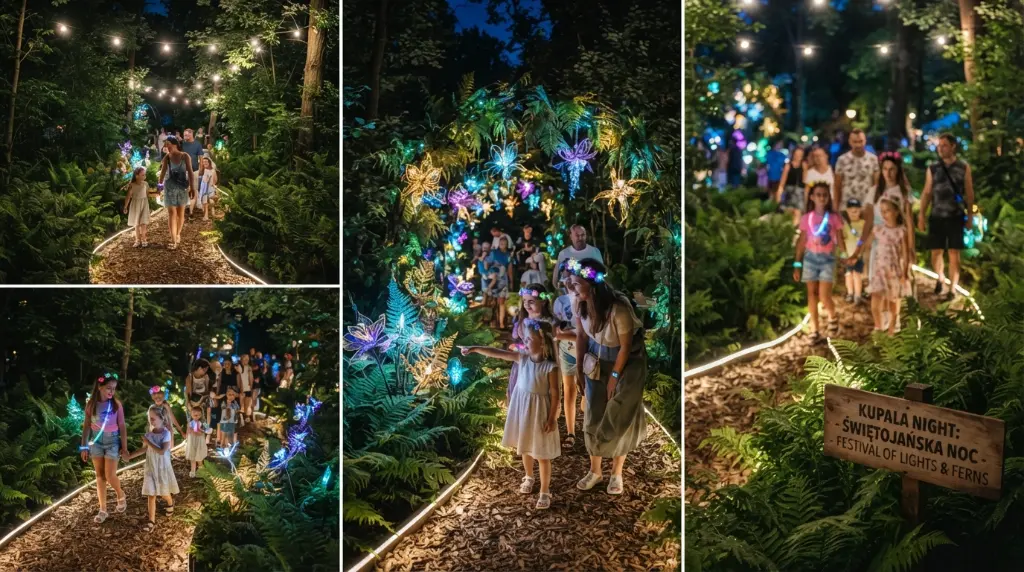
Across Poland, towns and cities organize midsummer festivals featuring:
- traditional folk music,
- historical reenactments,
- craft markets,
- riverside ceremonies,
- flower wreath competitions,
- bonfires,
- storytelling,
- dance performances.
Perhaps the most famous modern celebration is Wianki in Kraków.
Thousands of visitors gather along the Vistula River to watch concerts, admire illuminated wreaths floating across the water, and experience one of Poland’s most spectacular summer festivals.
Although today’s celebrations are festive rather than mystical, they preserve the atmosphere of wonder that has always surrounded the summer solstice.
Why These Legends Continue to Fascinate Us
In an age dominated by smartphones, satellites, and artificial intelligence, stories of witches and enchanted forests might seem outdated.
Yet interest in Slavic mythology has never been greater.
Books exploring ancient folklore regularly become bestsellers.
Video games inspired by Slavic legends attract millions of players worldwide.
Television series, fantasy novels, and films increasingly draw inspiration from Eastern Europe’s rich mythological traditions.
Why?
Because these stories speak to something timeless.
They remind us of a world where nature was sacred, every forest concealed mysteries, and human beings believed they were deeply connected to the land around them.
Kupala Night represents more than folklore.
It symbolizes humanity’s enduring desire to understand the unknown.
Did You Know?
🌿 Ferns Never Bloom
The legendary Fern Flower is impossible in nature.
Ferns reproduce through microscopic spores rather than flowers, making the legend one of Europe’s most beautiful symbolic myths.
🔥 Bonfires Could Reach Enormous Sizes
Historical accounts describe entire villages working together to build massive midsummer fires visible from neighboring communities several kilometers away.
🌼 Every Plant Had Meaning
Flower wreaths were not assembled randomly.
Different herbs represented health, love, courage, protection, or prosperity.
🌙 The Night Was Rarely Spent Sleeping
Many traditions encouraged staying awake until sunrise.
Witnessing the first rays of the morning sun was believed to bring good fortune throughout the coming year.
Frequently Asked Questions
Is Kupala Night still celebrated in Poland?
Yes. Many Polish cities and villages organize annual midsummer festivals inspired by ancient Slavic customs, especially around June 23–24.
Was Kupala Night originally a pagan festival?
Yes. It originated long before Christianity reached Poland and celebrated the summer solstice, fertility, nature, fire, and water.
Were Polish witches the same as Western European witches?
Not originally.
The early wiedźma was often viewed as a healer, herbalist, or wise woman possessing valuable knowledge of nature rather than an evil sorceress.
Why do people search for the Fern Flower?
The mythical flower symbolizes the pursuit of happiness, wisdom, and hidden treasures. It has become one of the best-known legends in Slavic folklore.
Is Kupala Night similar to Midsummer celebrations elsewhere in Europe?
Yes.
Many European cultures celebrate the summer solstice with bonfires, dancing, music, and rituals honoring nature. Kupala Night is the Slavic expression of this ancient seasonal tradition.
A Night Where Myth and Nature Meet
Long after the last bonfire fades and the flower wreaths disappear downstream, the magic of Kupala Night continues to live on—not because people still expect witches to emerge from the forests, but because the stories themselves remain part of Poland’s cultural identity.
The legends of wise women, enchanted herbs, moonlit rivers, and the impossible Fern Flower remind us that folklore is more than entertainment. It preserves the hopes, fears, and imagination of generations who viewed the natural world with awe and respect.
Whether celebrated beside a modern concert stage in Kraków or remembered through old family stories in a quiet village, Kupala Night continues to unite past and present.
It invites us to imagine a world where every flame carried meaning, every river whispered secrets, and every midsummer night held the promise that, for just a few magical hours, anything seemed possible.