Unraveling the Unbelievable: A Tour of 10 Strange Folk Costumes
Clothing is more than a covering; it’s a second skin that tells the story of who we are, where we come from, and what we believe. But in some corners of the world, this story is told in a language so visually arresting it defies our expectations of what clothing can be. This article will journey across continents to explore 10 of the strangest folk costumes on Earth—garments so extraordinary they blur the line between fashion, sculpture, and spiritual transformation.
We will delve into the histories and meanings behind these unbelievable ensembles, from terrifying Christmas monsters and living works of art to national dress codes and attire made of light and air. Prepare to witness how culture, history, and belief are woven into some of the most surreal and magnificent traditional clothing ever created.
1. The Aka Elephant Masks, Cameroon: Wearable Sculpture
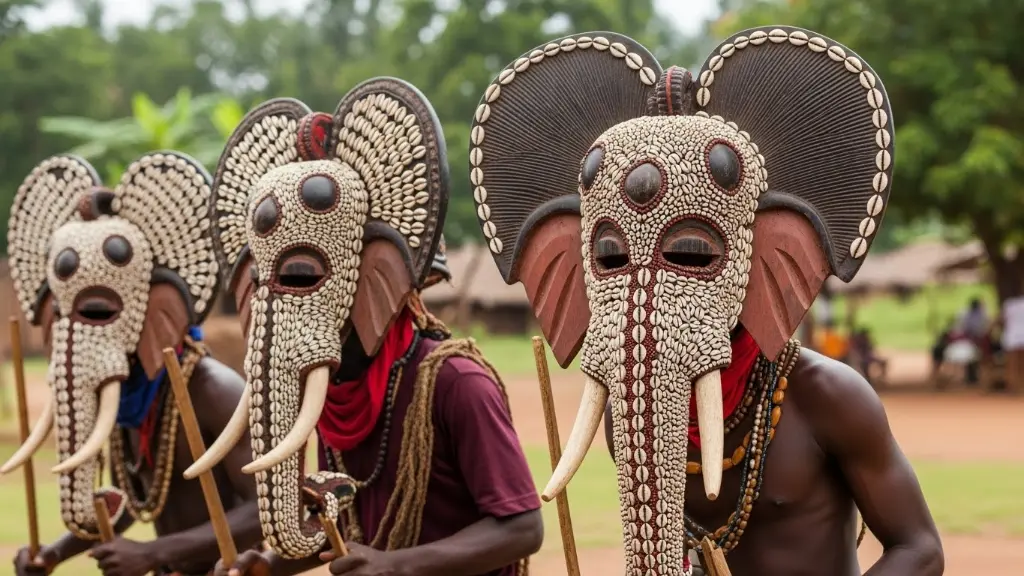
In the verdant Grassfields region of western Cameroon, the Bamileke people hold ceremonies where human dancers seem to transform into majestic, abstract beasts. This is achieved through the Aka elephant mask, one of the most powerful and visually stunning examples of African ceremonial art. These are not simple face coverings but complete ritual ensembles that function as wearable art.
The Anatomy of a Living Sculpture
The Aka costume is an intricate combination of mask, cape, and body ornament, designed to completely obscure the wearer and create a new, powerful being. Its components include:
See also What is Traditional Clothing? Exploring the Definition and Characteristics
- The Mask: A structured hood that covers the head, featuring a beaded, stylized human face.
- The “Trunk”: A long, heavily beaded panel that hangs down the front of the body, symbolizing the elephant’s trunk and representing power.
- The “Ears”: Two large, stiff circular panels attached to the sides of the head. These are often the most dramatic feature, richly decorated with geometric beadwork that represents the cosmic patterns of the Fon (the king).
- The Gown: A voluminous robe of indigo-dyed fabric, which provides a dark canvas for the brilliant beadwork to stand out.
Each costume is a masterpiece of craftsmanship, covered in thousands of glass beads, cowrie shells (historically a form of currency), and intricate embroidery. As art historian Alisa LaGamma notes, these performances are “dynamic displays of courtly wealth and power” where the wearer’s movements bring the sculptural costume to life (LaGamma, Heroic Africans: Legendary Leaders, Iconic Sculptures, 2011). The dancers become physical manifestations of the elephant—a royal symbol of strength, intelligence, and leadership.
2. The Herero Dress, Namibia: A Statement of Survival
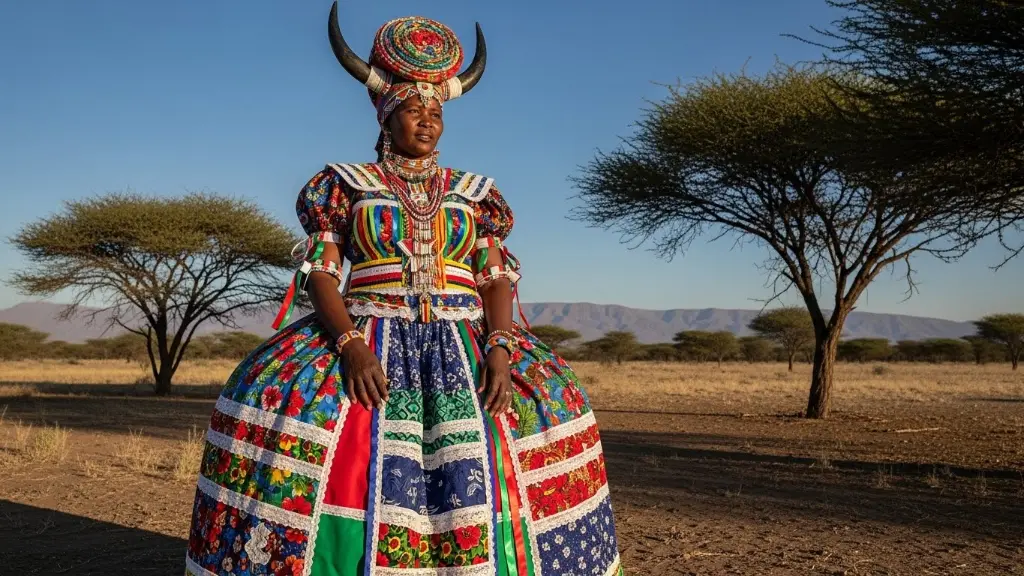
At first glance, the traditional dress of the Herero women of Namibia is a bewildering sight: a full-blown Victorian gown in the middle of the African savanna. This voluminous dress, known as the ohorokova, with its countless petticoats, high neckline, and puffed sleeves, seems utterly out of place. Yet, its presence is a profound and ironic statement of cultural resilience.
From Colonial Imposition to Cultural Pride
The style was originally introduced in the early 20th century by the wives of German missionaries and colonialists. However, the story took a dark turn. Between 1904 and 1908, the German Empire carried out a systematic genocide against the Herero people. In the aftermath, the surviving Herero women re-appropriated the dress of their oppressors. They transformed it from a symbol of colonial dominance into a proud memorial and a defiant expression of their survival and identity.
The most striking part of the ensemble is the otjikaiva, a magnificent horn-shaped headdress crafted from rolled-up fabric. Its shape pays homage to the cattle that are central to Herero culture and wealth. By pairing the German dress with their own symbolic headdress, the Herero women created a unique and powerful folk costume that honors their past while subverting its painful history. Today, wearing it is an act of remembrance and pride.
See also History of Traditional Clothing
To explore another culture’s use of clothing as identity, read our article on The Vibrant Language of the Sámi Gákti.
3. Krampus Costumes, The Alps: A Christmas Nightmare

While much of the world associates Christmas with jolly figures and gentle cheer, the Alpine regions of Austria, Germany, and beyond have a much darker tradition. Here, St. Nicholas is accompanied by Krampus, a horned, demonic beast whose role is to punish naughty children. The Krampus costumes are the stuff of nightmares, designed to be genuinely terrifying.
Crafting a Demon
These are not cheap Halloween getups but elaborate, handcrafted works of folk art. A traditional Krampus costume consists of:
- The Mask (Larve): Hand-carved from wood (often pine or linden), with a demonic face, grotesque features, a long, lolling tongue, and imposing horns from goats or rams.
- The Suit: A heavy suit made from the shaggy pelts of sheep or goats, usually in black or brown.
- The Bells: A belt of large, loud cowbells worn around the waist. The cacophonous clanging announces the arrival of the beast.
- The Accessories: Chains that are rattled menacingly and a bundle of birch branches used to swat at misbehaving onlookers.
The tradition dates back to pre-Christian pagan rituals intended to scare away the ghosts of winter. As folklorist Al Ridenour explains in The Krampus and the Old, Dark Christmas (2016), the “Krampus run” (Krampuslauf) is a form of anarchic street theater, a primal and visceral experience that stands in stark contrast to the commercialized sweetness of modern Christmas.
4. Gho and Kira, Bhutan: A Mandatory National Wardrobe
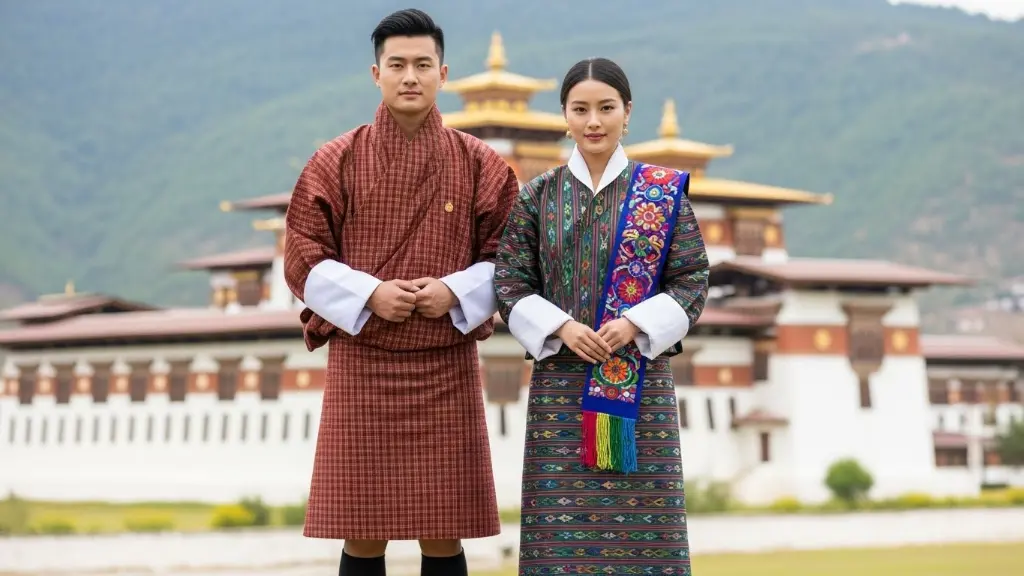
In the remote Himalayan kingdom of Bhutan, traditional dress isn’t just for festivals—it’s the law. The Driglam Namzha, or “the way of harmony,” is a national code of conduct established in the 17th century and promoted by the government today. It requires citizens to wear the national folk costume in public spaces, schools, and government offices.
For a global audience accustomed to choosing their daily outfits, this concept of a mandatory national dress seems almost unbelievable.
- For Men, the Gho: This is a knee-length robe, similar to a kimono, that is wrapped around the body and tied at the waist with a woven belt called a kera. The tying method creates a large pouch above the belt, which functions as the world’s largest pocket, used to carry everything from a wallet and mobile phone to a small bowl.
- For Women, the Kira: This is an ankle-length wrap-around dress, typically made from intricately woven cotton or silk brocade. It’s secured at the shoulders with ornate clips called koma and worn with a long-sleeved silk blouse (wonju) and a short outer jacket (toego).
While this traditional dress is an everyday reality for the Bhutanese, it serves as a powerful symbol of national unity and cultural preservation in the face of globalization. It is a living, breathing part of Bhutan’s identity.
5. Andean Ceremonial Ponchos, Peru & Bolivia: Woven Universes
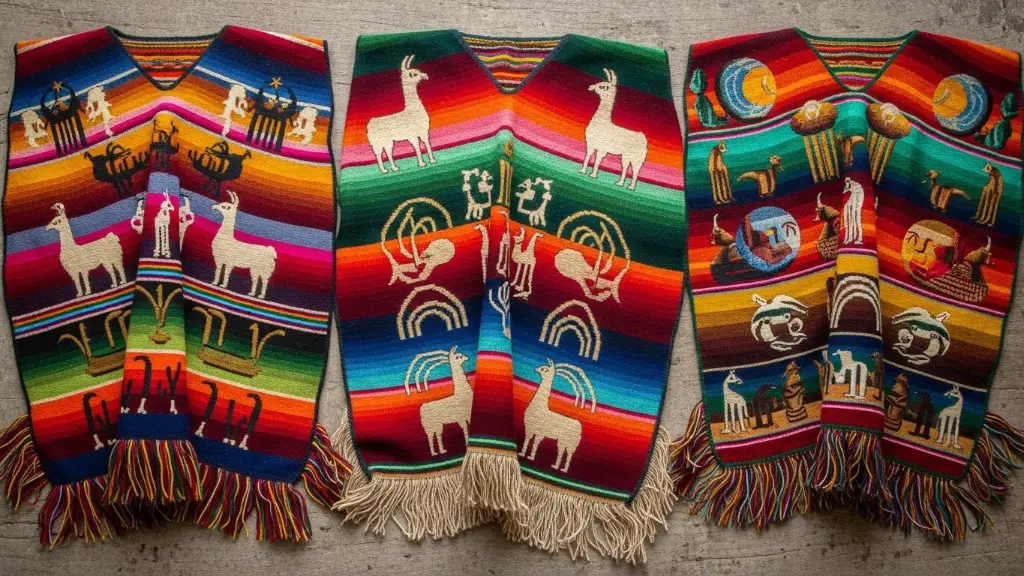
The poncho is a familiar garment, but the ceremonial ponchos of the high Andes are on another plane of existence entirely. These are not merely functional garments for warmth; they are dense, heavy, and symbolically rich textiles that serve as sacred maps of the cosmos. Worn by community leaders and during specific rituals, these Andean ceremonial ponchos are masterpieces of weaving rarely seen by the outside world.
Woven from the incredibly fine wool of alpacas and vicuñas, these ponchos are packed with meaning. The patterns, known as pallay, are a complex visual language. According to scholars like Mary Frame, who has studied Andean textiles, these geometric designs are not just decorative but represent “cosmological structures, social organization, and historical narratives” (Frame, Andean Four-Cornered Hats: Ancient Volumes, 1990).
Looking at one of these ponchos is like reading a sacred text. The colors, the layout of the stripes, and the specific motifs can communicate the weaver’s community, the wearer’s social status, and fundamental concepts of duality and balance that underpin the Andean worldview. Their weight and density make them feel less like clothing and more like a protective, sacred mantle.
6. The Sombrero Vueltiao, Colombia: A Hat of Mathematical Genius
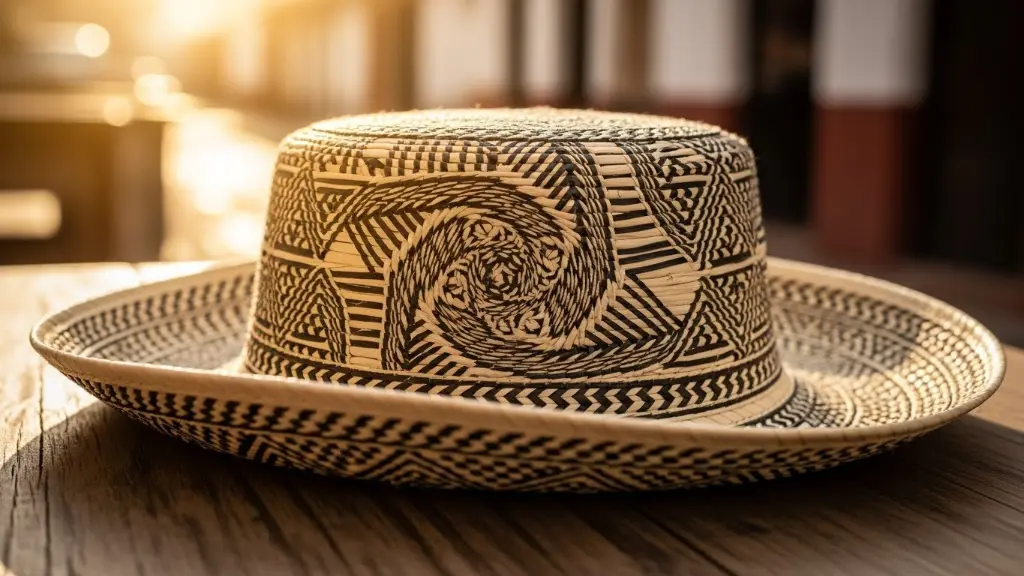
While a hat may seem like a simple accessory, the Sombrero Vueltiao of Colombia is an object of such complex craftsmanship and cultural significance that it has been designated a national symbol and recognized by UNESCO. Woven by the Zenú indigenous people of the Caribbean coast, this iconic black-and-white hat is a marvel of geometry and tradition.
It is made from the dried leaves of the caña flecha palm, which are braided into long strips that are then sewn together in a spiral. The intricate geometric patterns, called pintas, are not random decorations. They are ancient Zenú symbols representing elements of the natural and spiritual world, with names like “the frog’s leg,” “the fish scales,” or “the heartbeat.”
The quality of a Sombrero Vueltiao is determined by its “laps” (vueltas)—the number of pairs of fibers used in the braid. A standard hat might be a “15,” but a masterwork “21” or even “23” is so tightly woven it can hold water and is as flexible as fine cloth. It represents the pinnacle of a craft passed down through generations, transforming a simple hat into a profound piece of cultural attire.
7. The Sámi Gákti, Northern Europe: An Ancestral ID Card
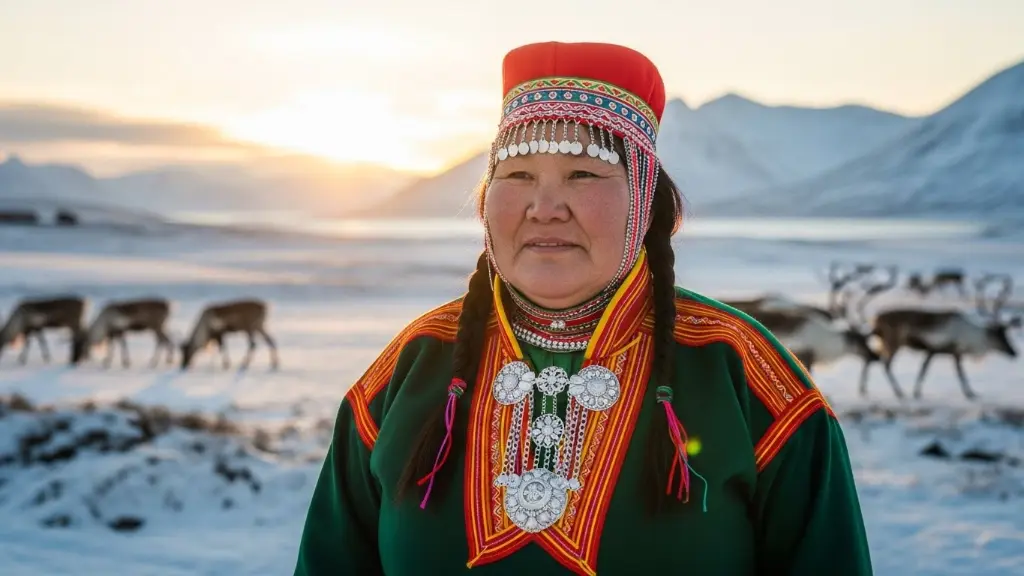
Across the arctic tundra of Sápmi (covering parts of Norway, Sweden, Finland, and Russia), the indigenous Sámi people wear a folk costume so vibrant and ornate it can look like it belongs in a fantasy epic. This is the gákti. Traditionally made from reindeer leather and wool, it is a tunic or dress ablaze with bright blues, reds, and yellows, adorned with intricate woven bands, pewter embroidery, and silver jewelry.
But the gákti is far more than a beautiful garment; it is a visual encyclopedia of the wearer’s identity. Every detail is a piece of information:
- Region: The length of the hem, the shape of the back, and the patterns on the woven bands can tell you which region the wearer is from.
- Family: Specific patterns and silver pieces can be tied to a particular family or clan.
- Marital Status: A person with a round-buttoned belt is single, while someone with a square-buttoned belt is married.
In a culture with a deep connection to land and lineage, the gákti functions as an ancestral ID card. “It tells you who I am and where I belong,” is a common Sámi expression regarding their traditional dress. It is a powerful statement of heritage and belonging.
8. Amazonian Ritual Ensembles: Dressed in Nature Itself
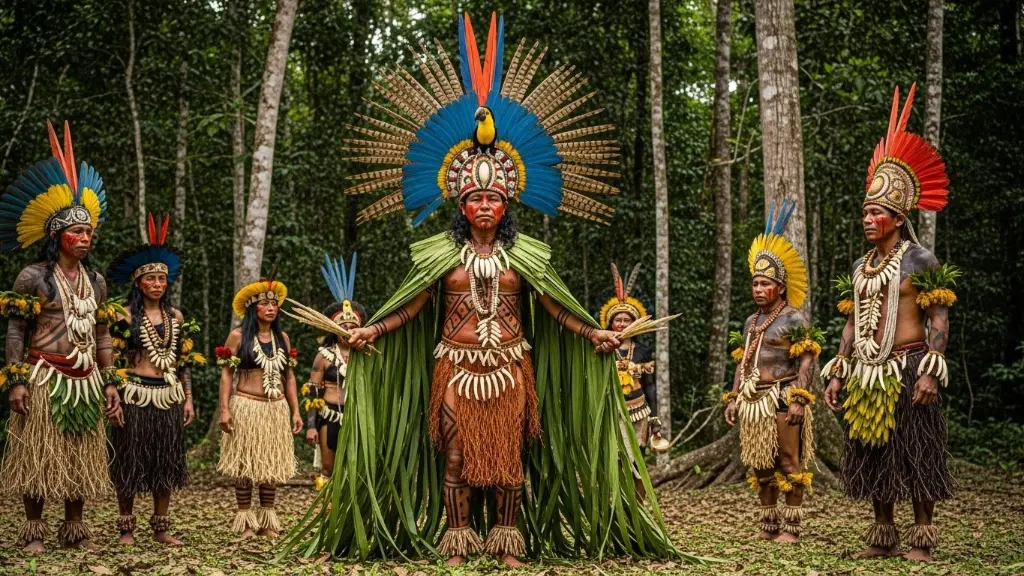
In many indigenous cultures of the Amazon basin, the Western idea of “clothing” as something that covers the body is entirely absent. Instead, ritual attire is an ensemble of body ornamentation that integrates the person with the natural and spiritual worlds. This form of dress is not meant to hide the body but to transform it into a canvas for sacred expression.
These ensembles are crafted entirely from the rainforest and are astonishing in their complexity and beauty. They may include:
- Featherwork: Magnificent headdresses, armbands, and back-pieces made from the iridescent tail feathers of macaws, toucans, and other birds.
- Body Paint: Intricate geometric or symbolic designs painted onto the skin using pigments from jungle plants like urucum (red) and genipapo (black).
- Jewelry: Necklaces, belts, and bracelets made from jaguar teeth, monkey bones, seeds, river shells, and insect wings.
For these cultures, getting “dressed” for a ceremony is a deeply spiritual act of becoming one with the forest and its powerful entities. This ritual garment challenges our most basic definitions of clothing, showing that attire can be made of light, color, and nature itself.
9. Regional Clothing of Iran: A Hidden Kaleidoscope
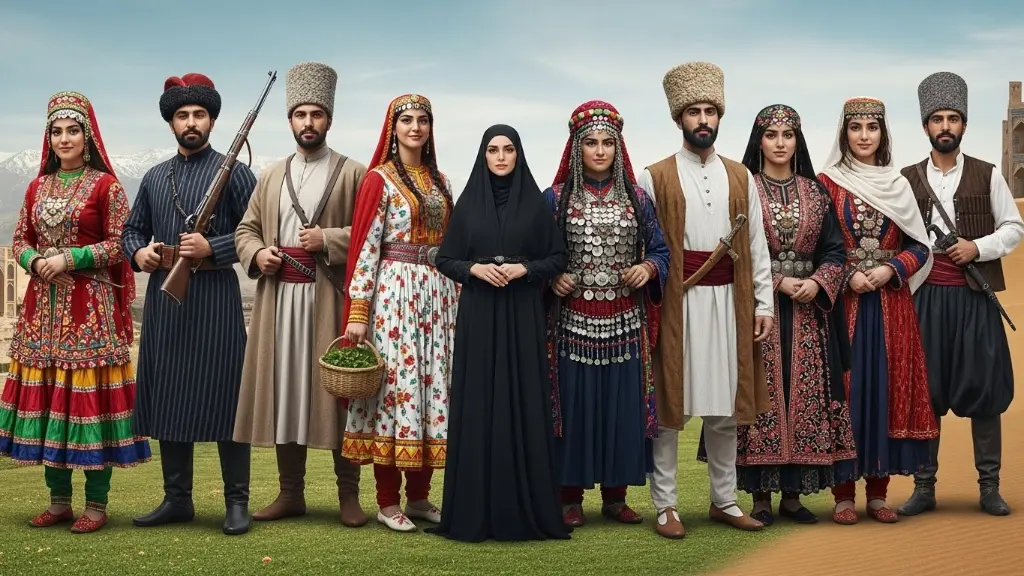
The image most of the world has of Iranian dress is the black chador. While prevalent, this monolithic image obscures a breathtaking diversity of regional folk costumes that look like they belong on a theatrical stage. Across the country’s many ethnic groups, traditional clothing explodes with color, layers, and intricate detail.
- Qashqai women in the south wear multiple, brilliantly colored, and voluminous skirts that create a spinning kaleidoscope of color when they walk or dance.
- Kurdish women in the west wear sequined vests, flowing dresses with long, decorative sleeves (fistan), and elaborate headscarves and jewelry.
- Bakhtiari men, a nomadic group, wear distinctive striped wool coats, wide trousers, and round felt hats.
These ensembles are not historical relics but are still proudly worn during weddings, festivals, and celebrations. They are a powerful expression of tribal identity, regional pride, and a rich history that defies simplistic stereotypes. Each outfit is a complex system of layers, sashes, vests, and jewelry, a testament to the vibrant and diverse cultural tapestry of Iran.
10. The Kukeri of Bulgaria: Banishing Evil with Fur and Fury
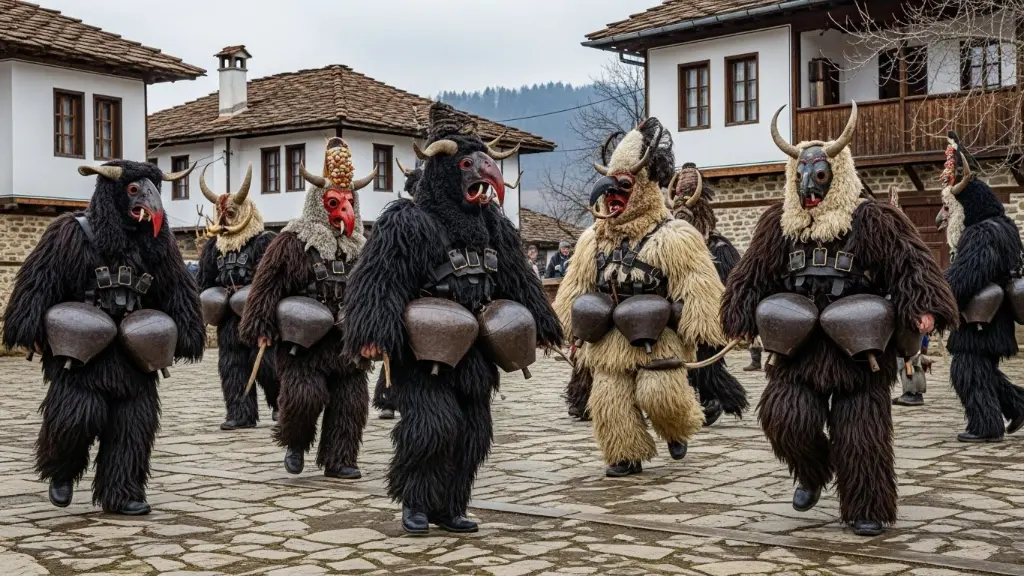
In the villages of Bulgaria, the end of winter is marked by a terrifying and exhilarating ritual. Men transform into monstrous, beast-like figures known as Kukeri. Their purpose is to perform ritual dances to chase away evil spirits, ensuring a healthy and fertile year ahead. The Kukeri costumes are designed to be as loud, large, and intimidating as possible.
The wearer is completely hidden inside a costume that can be made from goat or sheep hide, with the fur facing outwards to create a massive, shaggy silhouette. Ribbons, beads, and mirrors are often attached to the fur. The two most important elements are:
- The Mask: A towering, carved wooden mask, often with two faces (to see evil coming and going), painted in bright, symbolic colors. The mask can be adorned with horns, teeth, and feathers.
- The Bells: A heavy belt of large copper bells, weighing up to 40 kg (88 lbs), is tied around the waist.
As the Kukeri jump and dance through their village, the deafening clang of the bells and the fearsome sight of their costumes are believed to frighten away all malevolent forces. This ancient tradition is a visceral, powerful example of how a folk costume can be a tool for spiritual warfare.
The Enduring Power of Traditional Dress
From the wearable sculptures of Cameroon to the nightmare beasts of the Alps, these ten folk costumes reveal that clothing is one of humanity’s most creative and profound forms of expression. They are not simply “strange”; they are living documents of history, faith, and identity.
They show us that a dress can be a defiant political statement, a hat can be a map of the universe, and a mask can be a portal to the spirit world. In a rapidly globalizing world where mainstream fashion homogenizes our appearance, these traditions are more important than ever. They are vibrant testaments to the ingenuity of the human spirit and the deep need to visually declare who we are and what we believe. They are not just costumes; they are the soul of a people, worn on the outside.
We encourage you to continue exploring the rich tapestry of human culture. Which of these costumes did you find most unbelievable? Are there other strange folk costumes you know of? Share your thoughts in the comments below, subscribe for more deep dives into cultural traditions, and share this article to spark a conversation.
Intrigued by how history shapes clothing? Discover the story behind The Practicality and Power of Norman Clothing.
Frequently Asked Questions (FAQs)
Q1: Why are so many of these folk costumes related to spirits or monsters?
A: Many of these traditions, like the Krampus and Kukeri, have roots in pre-Christian pagan beliefs. These rituals were often tied to the cycles of nature, such as scaring away the darkness of winter to welcome the light of spring. The monstrous costumes were a way to personify these spiritual forces, confront them, and assert control over the unseen world, ensuring protection and fertility for the community.
Q2: Are these strange folk costumes still worn today?
A: Yes, all the costumes on this list are still actively worn, though their context may have evolved. Some, like the Gho and Kira in Bhutan, are daily wear. Others, like the Krampus and Kukeri costumes, are worn for specific annual festivals that are growing in popularity. The Herero dress and Sámi gákti are worn for special occasions and as powerful statements of cultural identity. They are living, evolving traditions.
Q3: What’s the difference between a costume and traditional clothing?
A: The line can be blurry, but generally, a “costume” is something worn to pretend to be someone or something else, often for a performance or party (like a Halloween costume). “Traditional clothing” or “folk dress” is the established attire of a specific culture or community, worn to express one’s own identity, heritage, and social standing. Many of the examples here, like the Kukeri, function as both—they are a traditional garment worn as part of a ritual performance where the wearer takes on a different persona.