Listen. Can you hear it? It’s the rhythmic clang of iron mail on a padded gambeson, the soft whisper of a wool mantle catching a North Sea wind, the confident stride of leather boots on stone. This was the soundscape of the Normans, a people whose ambition was as sharp as their swords and whose clothing was as strategic as their battle plans.
Their garments were never just garments. They were a brilliant, dual-purpose toolkit, engineered for two clear objectives: brutal practicality and the unmistakable projection of power. From the humble farmer’s tunic to the terrifying mail shirt of the knight, every layer was designed to function in a harsh world while simultaneously broadcasting a clear message of status, identity, and dominance.
This article pulls back the layers of the Norman wardrobe to reveal its genius. We will explore how their simple, layered clothing was a masterclass in practical design, how the cut and color of a garment could be a political statement, and how their armor became the ultimate fusion of life-saving function and awe-inspiring power. Prepare to see Norman clothing not as historical costume, but as the very fabric of their conquest.
📜 A People Dressed for Reinvention
To understand Norman clothing, you must first understand the Normans themselves: they were the ultimate adapters. Descended from Viking raiders who settled in France, they masterfully shed their “barbarian” image to become sophisticated, Christian, French-speaking dukes. Their clothing was their primary tool of rebranding.
See also 10 Folk Costumes So Strange They’re Hard to Believe
- From Raider to Ruler: Early Norman dress retained echoes of its Norse past—practical, rugged, and built for a life at sea. But as they integrated into the Frankish feudal system, they adopted the longer tunics, finer fabrics, and more elegant lines of continental nobility. This was a conscious choice. To rule in France, one had to look like a ruler of France.
- A Visual Claim to Legitimacy: When William the Conqueror crossed the channel in 1066, his army did not look like a band of Viking marauders. The knights depicted on the Bayeux Tapestry are shown in the fashionable, “modern” military attire of the European elite. Their clothing was a visual argument: “We are not foreign invaders; we are legitimate claimants to this throne, part of the same noble, Christian world.”
This talent for adaptation—for dressing for the job they wanted—is the key to understanding the dual nature of their attire.
💪 The Common Man’s Wardrobe: A Masterclass in Practicality
For the average Norman farmer, soldier, or craftsman, clothing was first and foremost a tool for survival and work. The design was simple, robust, and brilliantly layered, allowing for adaptation to the damp, chilly climate of Normandy and England.
The Foundation: Tunic, Braies, and Chausses
The core of the male wardrobe was a three-part system built for movement and warmth.
- The Braies (Under-Trousers): The innermost layer was a pair of loose-fitting linen trousers called braies. They were baggy, comfortable, and secured with a drawstring. For a laborer on a hot day, these might be worn alone. For everyone else, they were the anchor for the rest of the legwear.
- The Chausses (Leg Coverings): These were essentially two separate, tailored stockings, each covering one leg. They were made of wool and tied directly onto the braies’ belt. This separated design provided a fantastic range of motion—far more than modern trousers—essential for farming, riding, or fighting.
- The Tunic (Cotte): The main body garment was the tunic. For a commoner, this was a T-shaped, knee-length shirt made of coarse, undyed wool. Gores (triangular fabric inserts) were added to the sides and sleeves to create a wider skirt and allow for easy movement without wasting precious cloth.
This layered system was pure practical genius. It was warm, durable, and allowed for a full range of motion. It was the uniform of a man who worked.
See also What is Traditional Clothing? Exploring the Definition and Characteristics
The All-Purpose Overcoat: The Mantle 🧥
The primary piece of outerwear was the mantle, or cloak. This was the medieval equivalent of a raincoat, overcoat, and blanket all in one. Usually a simple rectangle or semicircle of heavy, thick wool, it offered vital protection from the elements.
Its practicality was enhanced by how it was worn. Most men fastened their mantle at the right shoulder with a simple brooch. This was a deliberate, functional choice: it left their right arm completely free and unencumbered for wielding a tool or a sword. It was the simple, brilliant design of a culture that always needed to be ready for action.
👑 The Noble’s Wardrobe: The Power of the Silhouette
While a Norman duke or baron wore the same basic layers as his subjects, his clothing was transformed into a declaration of power and status. The practicality was still there, but it was overshadowed by the message of wealth and leisure.
The Tunic as a Status Symbol ✨
The noble’s tunic was fundamentally different in two ways: length and material.
- Length: A nobleman, who did not perform manual labor, wore his tunic much longer, often to the ankle. This impractical length was the entire point. It was a visual cue that said, “My wealth is so secure that I do not need to work. My lands are tended by others.”
- Material: Instead of rough, undyed wool, the elite wore tunics of fine, soft wool or even imported silk. Most importantly, their garments were dyed in rich, vibrant colors.
The Lavish Mantle: A Cloak of Authority
The simple, practical mantle of the commoner became a canvas for aristocratic display.
- Rich Colors: A nobleman’s cloak would be dyed a deep, costly color like crimson or indigo, instantly marking him out in a crowd.
- Luxurious Linings: The inside would be lined with expensive fur—squirrel, marten, or fox—for warmth and as an ostentatious display of wealth.
- Ornate Brooches: The cloak was fastened not with a simple pin, but with a large, heavy brooch (fibula) of gold or silver, often decorated with intricate designs.
When a Norman lord swept into a hall, his long, richly colored, fur-lined mantle trailing behind him, the message was clear. This was a man of immense power, wealth, and importance.
💃 The Norman Lady: Dressing for Influence and Piety
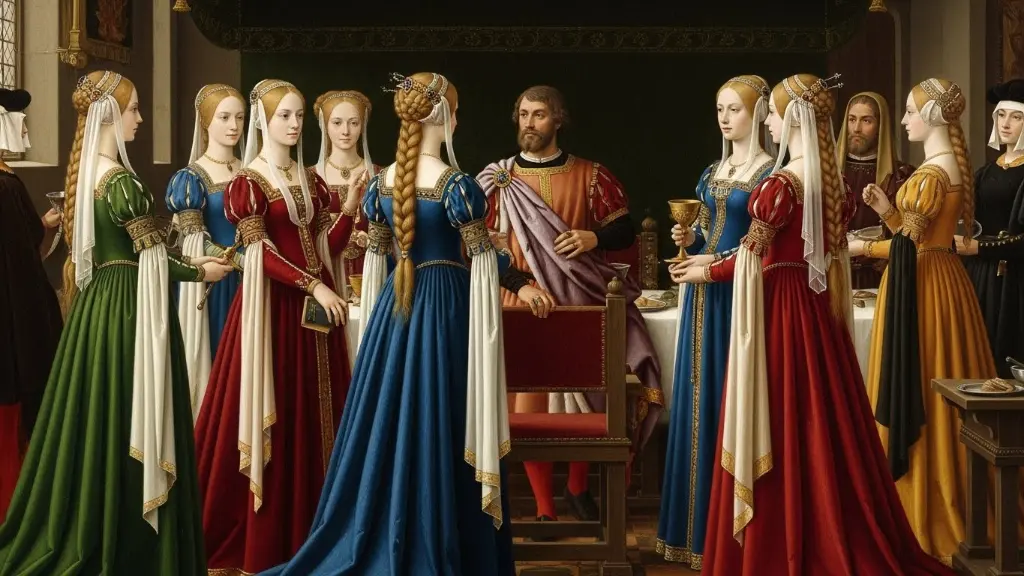
The clothing of noble Norman women was also a sophisticated blend of practicality (in a social sense) and power. Their attire emphasized modesty as demanded by the Church, but used luxurious fabrics and evolving silhouettes to display their family’s wealth and status.
The Rise of the Bliaut: A Revolution in Fit 👗
In the 12th century, Norman and French fashion pioneered a revolutionary new garment for women: the bliaut. This was a dramatic departure from the simple, loose tunics of the past.
Key Features of the Bliaut:
- A Fitted Torso: The bliaut was distinctively tight-fitting through the upper body, often achieved with lacing at the sides or back. This created a defined, elegant silhouette that was entirely new.
- Exaggerated Sleeves: The sleeves became a major fashion focus, ending in enormous, flowing cuffs that could hang almost to the floor.
- Pooling Skirt: The skirt was incredibly long and full, designed to pool on the ground around the wearer’s feet.
The bliaut was the ultimate power garment for a noblewoman. Its impracticality was its power. The tight fit, the trailing sleeves, and the floor-length skirt made any kind of manual labor impossible. It was a beautiful, wearable declaration of a life of pure leisure and high status, a feminine counterpart to the man’s ankle-length tunic.
The Veil: A Symbol of Modesty and Status 🕊️
For any adult noblewoman, a head covering was non-negotiable. The veil, a piece of fine linen or silk draped over the hair, was a symbol of her piety and her marital status. But it too could be a tool of power. The quality of the fabric—sheer, imported silk versus plain linen—and the way it was worn with a decorative circlet or crown could signal her rank and wealth just as clearly as her dress.
🛡️ Dressed for Battle: The Ultimate Fusion of Practicality and Power
Nowhere is the Norman genius for dual-purpose clothing more apparent than in the attire of the knight. His battle gear was a terrifyingly effective system of practical protection that also served as the ultimate status symbol of the medieval world.
The Unseen Layer: The Padded Gambeson
The first layer of defense was the gambeson—a thick, padded jacket made of quilted layers of linen or wool. A knight never wore his mail directly on his skin. The gambeson served two critical, practical purposes:
- Shock Absorption: Mail is excellent at stopping a sword cut, but it does little to absorb the blunt force of a mace or an axe. The gambeson acted like a medieval flak jacket, cushioning the blow and preventing broken bones.
- Chafe Protection: A 30-pound shirt of riveted iron rings would quickly chafe a wearer’s skin raw. The gambeson provided a comfortable, protective barrier.
The Shirt of Iron: The Hauberk ⛓️
The heart of the Norman knight’s defense was the hauberk, a long, knee-length shirt of mail armor. This was not the cheap “butted” mail of fantasy films. Every single iron ring was interlinked with four others and then painstakingly riveted shut. This created an incredibly strong, flexible, and nearly impenetrable wall of iron against slashing weapons.
- The Power of Cost: A riveted hauberk represented an astronomical cost in both materials and skilled labor. It could take a blacksmith months to produce. Owning one was like owning a supercar today. It was a piece of military hardware only the elite could afford, a clear sign that the man wearing it was a member of the warrior aristocracy.
- The Practicality of Design: It was long enough to protect the thighs but split in the front and back, allowing a knight to ride a horse comfortably. It was a perfect marriage of maximum protection and necessary mobility.
The Iconic Profile: The Nasal Helm and Kite Shield
The final elements created the terrifying and unforgettable silhouette of the Norman knight.
- The Conical Helm: A simple, cone-shaped helmet, often with a single bar of metal protecting the nose (the “nasal”). Its elegantly simple design was brutally practical: the cone shape caused sword blows to glance off rather than striking flat.
- The Kite Shield: A long, teardrop-shaped shield that was rounded at the top and tapered to a point at the bottom. This innovative design was large enough to protect most of the body while still being manageable, and its length was perfect for protecting a rider’s leg while on horseback.
When a line of Norman knights charged, their conical helms gleaming, their bodies encased in a river of iron mail, they were a vision of both military perfection and aristocratic power. Their clothing was their weapon.
Conclusion: A Legacy Woven in Wool and Iron
The clothing of the Normans was the perfect expression of who they were: pragmatic, ambitious, and obsessed with status. They understood that what you wear is a tool. It can keep you warm, it can protect you in a fight, and it can declare your right to rule.
Their layered woolens were a practical solution to a damp climate, while their long, flowing noble garments were a clear signal of a life free from labor. Their armor was a masterpiece of defensive engineering that simultaneously served as the most potent status symbol of its age. From the way a common soldier freed his sword arm to the way a lady’s impractical sleeves announced her leisure, every garment had a dual purpose.
The Norman legacy is not just in their castles and their laws. It is in this brilliant understanding that clothing is never just clothing. It is a language, a strategy, and a weapon. It is, and always was, a thread of conquest.
What aspect of Norman clothing’s dual purpose do you find most ingenious? Share your thoughts in the comments below! 👇
❓ Frequently Asked Questions about Norman Clothing
Q1: What’s the biggest misconception about Norman clothing?
A: The idea that it was all drab and brown. While poor people wore undyed wool, the nobility loved bright colors. The Bayeux Tapestry is a riot of reds, blues, and greens. Another myth is the horned helmet—the Normans wore simple, practical conical helms.
Q2: Was their clothing comfortable?
A: “Comfort” is relative. The natural fibers like wool and linen were breathable. The layered system was adaptable. The loose-fitting braies and separate chausses allowed for excellent freedom of movement. However, a noblewoman in a tightly laced bliaut or a knight in 50+ pounds of mail and padding was certainly sacrificing comfort for the sake of fashion and function.
Q3: How did they afford such expensive clothes and armor?
A: Through the feudal system. A Norman lord’s wealth was generated from his vast land holdings and the labor of the peasants who worked it. This wealth was then invested in the visible symbols of his power: castles, retinues of soldiers, and incredibly expensive attire and armor for himself and his family.
Q4: Did Norman clothing influence modern fashion?
A: Yes, in subtle ways. The Normans and their French contemporaries pioneered more advanced tailoring techniques, moving away from simple T-shaped garments. The idea of fitting a garment to the body, seen in the bliaut, was a major step that led directly to the more complex fashions of the later Middle Ages and, eventually, to modern tailoring. The concept of clothing as a clear and immediate status symbol is, of course, still with us today.