The Unraveling of Culture: Why Traditional Clothing Is Disappearing 💔
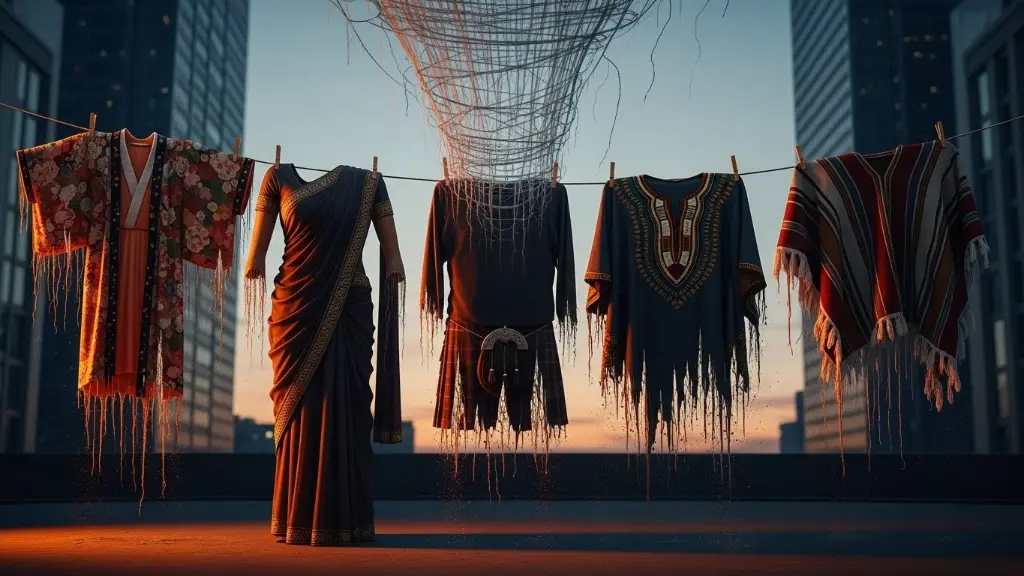
Look at a crowd in any major city in the world—Tokyo, Cairo, Mexico City, Lagos. What do you see? A sea of jeans, t-shirts, sneakers, and business suits. Now, close your eyes and imagine that same crowd a century and a half ago. The scene explodes into a breathtaking panorama of color and form: the elegant drape of a Japanese kimono, the vibrant embroidery of an Egyptian galabeya, the proud wrap of a Mexican serape, the intricate patterns of a Nigerian agbada.
Something profound has been lost. In the space of just a few generations, a rich and dazzling spectrum of human identity, woven into cloth over millennia, has been fading into a globalized monochrome. The decline of traditional clothing is one of the most visible, yet least discussed, cultural shifts of our time. It’s a silent extinction, happening not in a remote rainforest, but in our own closets and communities.
This is not a simple story of “old” versus “new.” The vanishing of our woven heritage is a complex tale of colonialism, economic pressure, social aspiration, and the seductive efficiency of mass-produced fashion. This article will explore the powerful forces causing this global shift and ask the crucial question: what do we truly lose when these ancient threads unravel?
🌍 The Rise of the Global Uniform: Why Is This Happening?
The shift away from traditional dress is not an accident. It is the result of powerful historical and economic currents that have reshaped the world. At the center of this story is the rise of what we might call the “Western Global Uniform”: the suit and tie for formal occasions, and jeans, t-shirts, and sportswear for casual life.
See also Forgotten Fashion Revival: Unlock Timeless Style Secrets Now!
1. The Long Shadow of Colonialism colonialism colonial rule 📜
The story begins with the colonial era. When European powers expanded across the globe, they brought with them not just their armies and administrators, but their culture and their dress code. The Western suit became the uniform of power.
- A Symbol of “Civilization”: Colonial administrators and missionaries often viewed local dress as “primitive,” “uncivilized,” or “pagan.” Adopting Western clothing was actively encouraged, and sometimes forced, as a sign of conversion and assimilation. To be educated in a mission school or to get a job in the colonial government meant trading your sarong or boubou for trousers and a starched collar.
- Internalizing the Stigma: Over time, this colonial mindset was internalized by local populations. Traditional clothing became associated with rural poverty and a “backward” way of life, while Western dress symbolized modernity, education, and upward mobility. As historian H.L. Wesseling noted, the adoption of Western dress was a key part of the “process of modernization that was both embraced and imposed” (Wesseling, 1996).
This historical trauma created a deep-seated cultural cringe, a sense that one’s own heritage was inferior. The seeds of decline were sown.
2. The Economic Machine: The Age of Fast Fashion 💸
If colonialism started the fire, the modern global economy has fanned its flames. The rise of fast fashion has made Western-style clothing cheaper, more accessible, and more desirable than ever before.
- The Cost Factor: A hand-woven Scottish kilt or a block-printed Indian sari requires immense skill and dozens of hours of labor. The materials—high-quality wool, pure silk—are expensive. A mass-produced polyester t-shirt from a factory in Bangladesh, on the other hand, can be made in minutes and sold for a few dollars. For many people, the economic choice is clear.
- The Practicality Argument: Traditional garments are often seen as impractical for modern urban life. A long, flowing kimono is difficult to wear while riding a subway or working in a modern office. A pair of jeans, designed as rugged workwear, is durable and requires little maintenance. The “Global Uniform” is, above all, efficient.
- The Loss of Artisans: As demand for traditional garments plummets, the artisans who possess the ancient skills of weaving, dyeing, and embroidery find themselves unable to make a living. The knowledge passed down through generations—how to create a specific ikat pattern, how to extract a rare natural dye—is at risk of dying out with them. Without the makers, the garments cannot survive.
3. The Power of Media and “Soft Power” 🎬
Today, the most powerful colonizing force is not an army, but a Hollywood movie, a pop song, or a viral TikTok video. Western media has created a powerful, globalized ideal of what it means to be “cool,” “successful,” and “beautiful.”
See also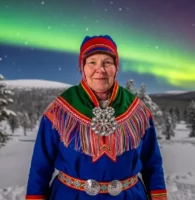 Woven in the Arctic Light: The Living Language of the Sámi Gákti ❄️
- The Hollywood Effect: From James Dean making blue jeans an icon of rebellion to the latest superhero movie, American and European media project a vision of the world where the heroes, the lovers, and the power players wear Western clothes. This creates a powerful aspirational link.
- The Social Media Mirror: Platforms like Instagram and TikTok accelerate this trend. Influencers from around the world often adopt a globalized aesthetic, further cementing the “Western Uniform” as the default look for a modern, connected individual. Traditional clothing is often relegated to a “costume” for special occasions or a nostalgic throwback post.
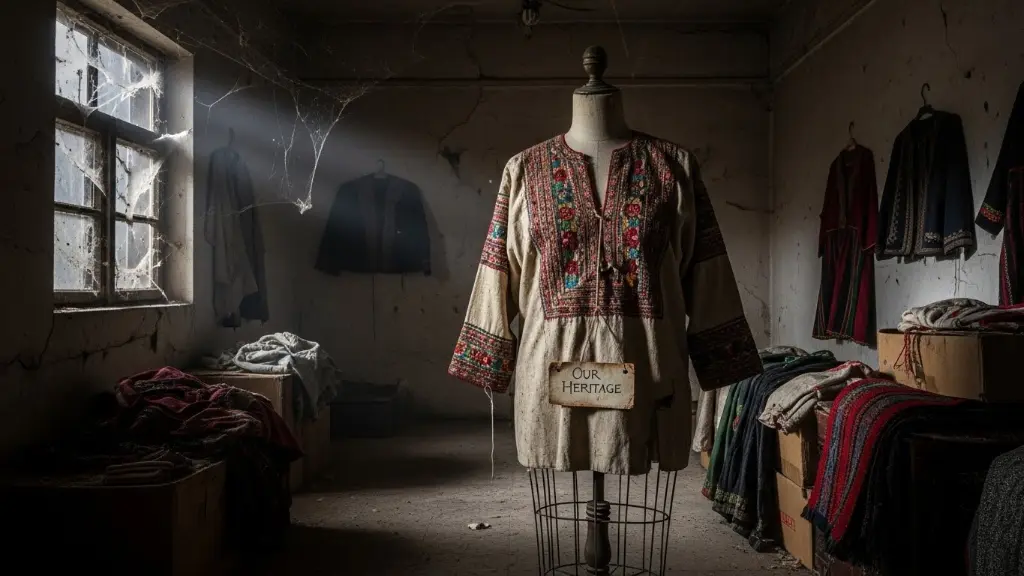
💔 More Than Cloth: What We Lose When Heritage Vanishes
So what? Does it really matter if everyone wears jeans and a t-shirt? If it’s more practical and cheaper, isn’t this just a natural evolution?
To think this way is to misunderstand what traditional clothing truly is. It is not just decorative fabric. It is a library of cultural knowledge, a language of identity, and a connection to our ancestors. When it vanishes, we lose so much more than just a style.
1. The Loss of Identity and Story 🗺️
Traditional garments are a visual language. They tell a story about who you are and where you come from.
- A Map of Origin: The specific embroidery on a Palestinian thobe could tell you which village a woman was from. The tartan of a Scottish kilt declared a man’s clan allegiance. This geographical and social identity is erased by the anonymity of a mass-produced shirt.
- A Story of Status and Life Stage: The number of stripes on a Maasai warrior’s cloth, the way a woman in the Andes wears her pollera (skirt), or the color of a Vietnamese áo dài could signify marital status, age, or social standing. This rich, non-verbal communication is lost.
- Symbolism and Spirituality: The patterns on a Ghanaian Kente cloth are not just pretty designs; they are proverbs and stories woven in thread. The mirrors on a Rajasthani lehenga are meant to ward off the evil eye. This spiritual dimension is absent from a pair of cargo shorts.
When we lose these garments, we lose the stories they tell about us. We become, in a visual sense, disconnected from our own unique place in the world.
2. The Loss of Priceless Skills and Knowledge 🧠
The decline of traditional clothing means the extinction of irreplaceable human knowledge.
- The Weaver’s Art: The skill to create a double-ikat patola from India, where both the warp and weft threads are dyed before weaving, is a level of mathematical and artistic genius that takes a lifetime to master.
- The Dyer’s Secrets: The knowledge of which roots produce a deep crimson, which lichens a vibrant purple, and how to use a specific mordant to make the color last—this is a form of chemistry passed down through oral tradition.
- The Tailor’s Touch: The art of draping a sari or folding the pleats of a Japanese hakama is a physical skill, a form of bodily knowledge that disappears when everything is secured with a zipper and a button.
As UNESCO has recognized through its Intangible Cultural Heritage lists, this knowledge is a treasure of all humanity. When an elder artisan dies without an apprentice, a library of human ingenuity burns to the ground.
3. The Environmental Cost of Forgetting 🌿
Ironically, the shift away from “old-fashioned” clothing has been an environmental disaster.
- Sustainable by Nature: Traditional clothing was, by its very nature, sustainable. It was made from local, organic materials like wool, cotton, linen, and silk. It was dyed with natural plant and mineral dyes.
- Made to Last: These garments were not disposable. They were made to last a lifetime, to be mended, cared for, and passed down through generations. A woman’s wedding sari became a blanket for her child, and later, a quilt for her grandchild.
- The Fast Fashion Footprint: In contrast, the modern fashion industry is one of the world’s biggest polluters. It relies on fossil-fuel-based synthetic fabrics like polyester, uses vast amounts of water and toxic chemical dyes, and operates on a model that encourages constant, wasteful consumption.
In abandoning our ancestral ways of dress, we have traded a circular, sustainable model for a linear, destructive one.
🌱 The Threads of Revival: Can We Save Our Woven Heritage?
The story is not over. Around the world, a powerful counter-movement is growing. A new generation is discovering the beauty, meaning, and power of their ancestral dress. They are fighting to keep these threads from unraveling.
How is this revival happening?
- Cultural Pride and Identity Politics: For many marginalized and post-colonial communities, reclaiming traditional dress is a powerful political act. It is a way of rejecting colonial standards of beauty and proudly asserting one’s own identity. Wearing an Ankara print dress in London or a dashiki in New York is a statement: “I am here, and I will not erase my heritage.”
- The “New” Artisans: Young designers are taking traditional techniques and fabrics and incorporating them into modern, wearable fashion. They are creating pieces that honor the past while feeling relevant to the present. This creates a new market and provides a lifeline to traditional artisans.
- The Power of the Diaspora: Communities living outside their ancestral homelands often feel a particularly strong pull to maintain cultural traditions. For them, wearing traditional clothing for weddings, festivals, and religious ceremonies is a vital way to stay connected to their roots and pass their heritage on to the next generation.
- Ecotourism and Ethical Fashion: A growing number of consumers are looking for ethically made, sustainable clothing with a story. This has created a niche market for authentic, handmade textiles, allowing travelers and conscious consumers to support artisan communities directly.
Conclusion: A Wardrobe of Who We Are
The decline of traditional clothing is a quiet tragedy. It represents the erosion of identity, the loss of irreplaceable knowledge, and a disconnect from the sustainable practices of our ancestors. Each time an elder weaver puts down her shuttle for the last time, we lose another verse of the human poem.
But the threads have not yet broken completely. In the vibrant colors of a festival, in the proud stance of a young person reclaiming their heritage, in the careful hands of a designer blending old with new, there is hope. The fight to save our woven heritage is a fight to save the stories that make us who we are.
Perhaps the future is not a choice between a traditional caftan and a pair of jeans. Perhaps the future is a world where our closets can hold both—where we can embrace the convenience of the modern world without severing the sacred threads that connect us to our ancestors, our earth, and our own unique souls. Our heritage is not a costume to be worn once a year. It is a living, breathing part of us, and it is worth fighting for.
Is there a traditional garment from your own heritage that you feel is being lost? Share its story in the comments below. Let’s create an archive of memory for these beautiful and important traditions. 👇
❓ Frequently Asked Questions about the Decline of Traditional Clothing
Q1: Isn’t it a good thing that people can wear whatever they want?
A: Absolutely. Freedom of choice is essential. The issue is not that people are choosing to wear modern clothes, but why they are making that choice. Often, it’s not a free choice but one driven by powerful economic pressures, social stigma against traditional dress, and a lack of access to affordable, authentic garments. The goal is a world where choosing to wear traditional clothing is just as valid, respected, and practical as choosing to wear a t-shirt.
Q2: Can tourists help by buying traditional clothes?
A: Yes, but it must be done thoughtfully. The best way to help is to buy authentic, handmade items directly from the artisans or from certified fair-trade cooperatives. This ensures the money goes to the community and supports the continuation of the craft. Avoid buying cheap, mass-produced “souvenir” versions, as they often exploit the designs without supporting the culture.
Q3: Are some traditional garments actually being revived?
A: Yes! There are many wonderful success stories. The global popularity of vibrant African Ankara prints has created a booming industry for designers across the continent and in the diaspora. In Japan, there is a growing subculture of young people who enjoy wearing the kimono for everyday outings, not just for formal events. The revival is often led by the youth, who are finding new and creative ways to be proud of their heritage.
Q4: Is it appropriation for someone outside the culture to wear traditional clothing?
A: This is a complex and highly debated topic. The key is context, respect, and power dynamics. Wearing a sacred ceremonial garment as a party costume is appropriation. However, wearing a garment you bought from a local designer while visiting their country, in a way that is respectful and appreciative, is often seen as a form of cultural exchange. The best practice is to listen to people from that culture. If they are inviting you to wear it, or selling it to you as an item to be worn, it is generally a positive interaction.