Beyond the Monolith: A Journey into the Rich Diversity of the Arab World 🌍
Breathe in. Can you smell it? It might be the sharp, citrusy perfume of preserved lemons in a Moroccan souk, the sweet scent of cardamom-laced coffee in a Saudi majlis, or the bright, fresh aroma of parsley and mint in a Lebanese tabbouleh. Now listen. Can you hear it? It could be the haunting, Andalusian melodies of an oud in Tunis, the powerful, soul-stirring voice of Umm Kulthum echoing from a Cairo café, or the joyful, clapping rhythm of Khaliji music in Dubai.
For too long, the “Arab world” has been painted with a single brush, depicted as a vast, homogenous monolith of desert, camels, and a single, unchanging culture. This image is not just incomplete; it is a profound illusion. The reality is a breathtaking, vibrant, and deeply complex tapestry of 22 distinct nations, each with its own unique history, dialect, cuisine, and soul.
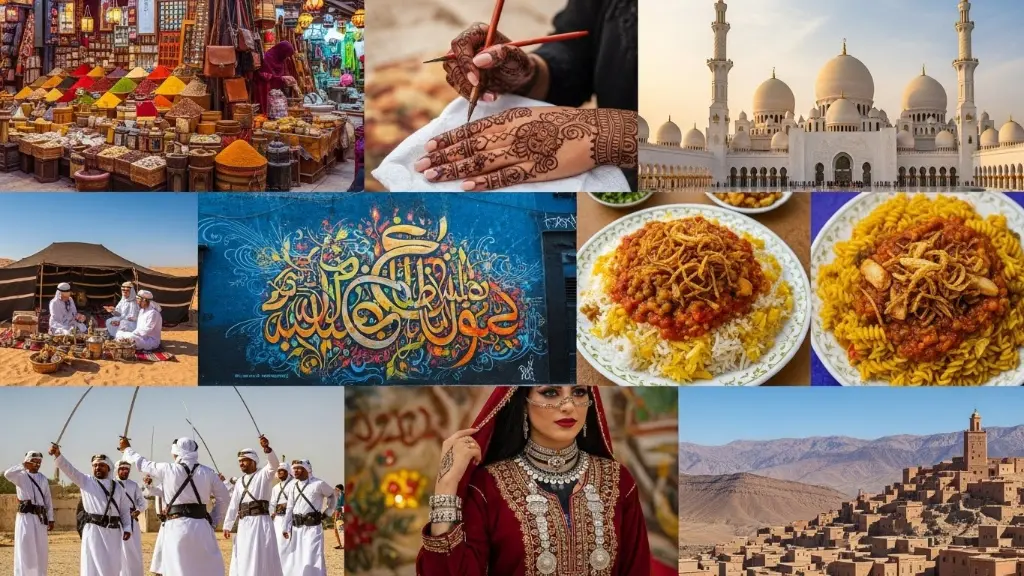
This article is an invitation to shatter that illusion. We will journey from the shores of the Atlantic to the sands of the Arabian Gulf, exploring the stunning cultural diversity in Arab countries. We will uncover the mosaics of faith, the spectrum of languages, the feast of flavors, and the symphony of arts that make up this incredible region. Prepare to discover a world not of one story, but of a thousand and one.
🗺️ The Myth of a Single “Arab World”
First, let’s define our terms. The “Arab world” generally refers to the 22 member states of the Arab League. This vast territory stretches over 5 million square miles, from Mauritania on the Atlantic coast of Africa to Iraq in the heart of Mesopotamia. It is home to over 400 million people.
See also Craft Revival: Why Hand Embroidery and Traditional Weaving Are Taking Fashion by Storm
So what unites them? Primarily, language. “Arab” is a cultural and linguistic identity, centered on the shared heritage of the Arabic language. It is not a racial or ethnic identity. The people of the Arab world are incredibly diverse, with roots that are Amazigh (Berber), Nubian, Kurdish, Circassian, Armenian, and from countless other ancient peoples who have called this land home for millennia.
The Lebanese-French author Amin Maalouf, in his book In the Name of Identity, powerfully captures this complexity: “My identity is what prevents me from being identical to anybody else” (Maalouf, 1998). This is the perfect lens through which to view the Arab world—a collection of unique identities, not a uniform bloc.
🗣️ A Tapestry of Tongues: The Linguistic Diversity
While Arabic is the unifying cord, it is not a monolithic language. Its diversity is one of the most immediate and striking examples of Arab cultural richness.
The Spectrum of Arabic Dialects (Darija)
The formal, written Arabic found in the Quran and in official news broadcasts is known as Modern Standard Arabic (MSA) or Fus’ha. This is the language of literacy and formal communication. However, the language of daily life, the language of the home and the heart, is Darija—the local dialect. These dialects are so distinct that a speaker from Morocco and a speaker from Iraq might struggle to understand each other.
See also Noc Kupały: Poland’s Ancient Night of Fire, Water, and Magic
| Region | Dialect Group | Example: “How are you?” | Key Influences |
|---|---|---|---|
| The Maghreb (Morocco, Algeria, Tunisia) | Maghrebi Arabic | Labas? / Kidayr? | Amazigh (Berber), French, Spanish |
| The Nile Valley (Egypt, Sudan) | Egyptian Arabic | Izzayak? (m) / Izzayik? (f) | Coptic, Ottoman Turkish |
| The Levant (Lebanon, Syria, Jordan, Palestine) | Levantine Arabic | Keefak? (m) / Keefik? (f) | Aramaic, French, Turkish |
| The Gulf (Saudi Arabia, UAE, Qatar, etc.) | Gulf Arabic (Khaliji) | Shlonak? (m) / Shlonik? (f) | Persian, English |
This dialectal diversity is a source of both pride and humor. Egyptian Arabic, thanks to Egypt’s massive film and music industry, is the most widely understood dialect. Maghrebi dialects, with their heavy Amazigh and French influences, are often considered the most distinct from the others.
Languages Beyond Arabic 📜
The linguistic landscape is further enriched by numerous non-Arabic languages that have been spoken in the region for thousands of years, long before the arrival of Arabic.
- Amazigh (Berber) Languages: Spoken by millions across North Africa (the Maghreb), the Amazigh languages are not a single tongue but a family of languages, including Tarifit, Tashelhit, and Kabyle. In Morocco and Algeria, Amazigh is now an official language, and its unique Tifinagh script is a proud symbol of deep indigenous heritage.
- Kurdish: Spoken by millions of Kurds, primarily in northern Iraq, Kurdish is an Indo-European language (related to Persian) with its own rich literary tradition. In Iraqi Kurdistan, it is the official language of government and education.
- Aramaic/Syriac: The language Jesus spoke, Aramaic was once the lingua franca of the entire Middle East. Today, its dialects (like Syriac and Mandaic) are still spoken by ancient Christian and Mandaean communities, primarily in Syria and Iraq. To hear it spoken is to hear a living echo of the ancient world.
- Nubian: In southern Egypt and northern Sudan, the Nubian people speak languages that descend from the tongue of the powerful Kingdom of Kush. Their language is a direct link to a glorious pharaonic African civilization.
🙏 Mosaics of Faith: A History of Religious Pluralism
The stereotype of the Arab world as exclusively Muslim is perhaps the most pervasive. While Islam is the majority religion, the region is the birthplace of all three Abrahamic faiths, and its history of religious diversity is deep and profound.
The House of Islam: More Than One Room 🕌
Even within Islam, there is immense diversity. The primary division is between Sunni and Shia Islam, a split that originated in a 7th-century dispute over succession to the Prophet Muhammad. While most Arab countries have a Sunni majority, countries like Iraq, Bahrain, and Lebanon have very large and influential Shia populations.
Beyond this, there are different schools of Islamic law (madhhabs), such as the Maliki school prevalent in North Africa and the Hanbali school in Saudi Arabia, which lead to different cultural practices and legal interpretations. Furthermore, the mystical tradition of Sufism has left an indelible mark on the region’s art, music, and philosophy, with its emphasis on love, poetry, and a personal connection to God.
Ancient Christian Roots ✝️
Long before the advent of Islam, the Middle East was a Christian heartland. The apostles walked its roads, and the first church fathers wrote and preached in its cities. These ancient Christian communities endure to this day, a testament to incredible resilience.
- The Copts of Egypt: The Coptic Orthodox Church is one of the oldest Christian denominations in the world. Copts are the direct descendants of the ancient Egyptians, and their language is the final stage of the ancient Egyptian tongue.
- The Maronites of Lebanon: An Eastern Catholic church in full communion with the Pope in Rome, the Maronites have played a central role in the formation of modern Lebanon.
- Orthodox Churches: The Greek Orthodox and Syriac Orthodox churches of the Levant (Syria, Jordan, Palestine) have a history stretching back to the very beginnings of Christianity. Their liturgies are chanted in Greek and Aramaic, a living link to the apostolic age.
The Enduring Jewish Heritage ✡️
Jewish communities have thrived in the Middle East and North Africa for millennia, long before the founding of the State of Israel. These Mizrahi (“Eastern”) Jews developed unique traditions, cuisines, and musical styles that were deeply integrated into the broader Arab culture. Great Jewish philosophers like Maimonides wrote their seminal works in Arabic. While mass emigrations in the mid-20th century dramatically reduced these populations, historic Jewish quarters, synagogues, and cultural traditions still exist, particularly in Morocco and Tunisia, as a reminder of this shared heritage.
🍲 The Flavors of the Land: A Culinary Journey
There is no better way to taste cultural diversity than through food. The Arab culinary world is a feast of regional specialties, shaped by geography, history, and local ingredients.
The Maghreb: Realm of Tagine and Couscous 🍋
North African cuisine is a slow-cooked symphony of sweet and savory.
- The Tagine: The iconic conical clay pot is used for slow-stewing everything from lamb with apricots and almonds to chicken with preserved lemons and olives.
- Couscous: The Friday staple, a dish of fine semolina granules steamed over a fragrant stew of meat and vegetables.
- Influences: The cuisine is rich with Amazigh (Berber) staples, Andalusian flavors from Moorish Spain, and a sophisticated touch of French patisserie.
The Levant: The Feast of Mezze 🌿
The cuisine of the Levant is a bright, fresh, and communal affair, famous for its mezze—a spread of small dishes meant for sharing.
- The Stars: Think of creamy hummus, smoky baba ghanoush, vibrant tabbouleh, and crispy falafel.
- National Dishes: Jordan’s national dish, Mansaf, is a celebratory meal of lamb cooked in a tangy fermented yogurt sauce, served on rice.
- Philosophy: Levantine food is about hospitality, generosity, and the joy of a shared table.
The Gulf: The Perfume of Spice and Rice 🍚
Gulf cuisine is defined by its history as a hub of the spice trade. It’s a world of aromatic rice dishes and fragrant stews.
- Kabsa: The quintessential dish of Saudi Arabia and its neighbors, a heaping platter of spiced rice and slow-cooked meat (chicken, lamb, or goat), fragrant with cardamom, saffron, cinnamon, and lime.
- Coffee Culture: The ritual of preparing and serving gahwa (lightly roasted, cardamom-infused coffee) in tiny cups is a cornerstone of Gulf hospitality and is inscribed as a UNESCO Intangible Cultural Heritage.
The Nile Valley: The Bounty of the River 🇪🇬
Egyptian and Sudanese food is hearty, ancient, and rooted in the fertile land of the Nile.
- Ful Medames: The national dish of Egypt, a rich stew of slow-cooked fava beans, is a breakfast staple for millions.
- Koshari: A uniquely Egyptian creation, a carb-heavy street food masterpiece layering rice, lentils, and macaroni, topped with a spicy tomato sauce and crispy fried onions. It is the ultimate comfort food.
🎨 The Arts of the People: Music, Architecture, and Dress
The artistic expressions of the Arab world are as diverse as its landscapes.
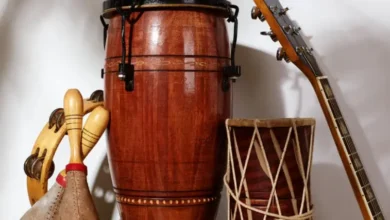
Echoes of the Oud and Rhythms of the Darbuka 🎶
- North Africa: Home to the refined, classical Andalusian music that traces its roots to Moorish Spain, full of complex melodies played on the oud and violin.
- Egypt: The powerhouse of Arab music. The 20th century was dominated by the legendary voices of Umm Kulthum and Abdel Halim Hafez, whose epic, orchestral songs are still beloved across the entire region.
- The Gulf: Known for Khaliji music, with its distinctive rhythmic structures, use of clapping, and celebratory feel.
Blue Courtyards and Soaring Minarets 🕌
- The Riads of Morocco: The traditional Moroccan house, with its stunning interior courtyard, intricate tilework (zellige), and carved plaster, offers a hidden paradise away from the bustling street.
- The Blue of Sidi Bou Said: The clifftop village in Tunisia, with its stark white buildings and brilliant blue doors and windows, is a perfect example of Mediterranean architectural bliss.
- The Towers of the Gulf: In stark contrast, cities like Dubai and Doha have become showcases for hyper-modern, gravity-defying architecture, creating a new, futuristic vision of the Arab city.
Threads of Identity: Regional Dress 👘
- The Maghrebi Djellaba: A long, loose-fitting hooded robe worn by both men and women in North Africa, perfect for both the desert heat and cool evenings.
- The Palestinian Thobe: A woman’s traditional dress, famous for its exquisite, colorful cross-stitch embroidery known as Tatreez. The patterns and colors can identify which village a woman is from.
- The Gulf Thobe and Ghutra: The crisp white thobe (a long robe) and the red-and-white or all-white ghutra (head covering) worn by men in the Gulf is an iconic image of the region, designed for comfort and modesty in the desert climate.
Conclusion: A Symphony of Cultures
The Arab world is not a single note played on a single instrument. It is a grand and glorious symphony, a kaleidoscope of cultures, a living mosaic of peoples who share a common linguistic heritage but express it in a thousand different ways. The diversity found in its dialects, its faiths, its foods, and its arts is not a sign of division; it is the region’s greatest strength and its most profound beauty.
To look beyond the stereotype is to see a world rich with history, resilience, and creativity. It is to understand that a Moroccan, an Egyptian, and an Emirati are connected by a shared language, but are also the proud heirs of their own unique and precious local cultures. In celebrating this diversity, we don’t just learn about the Arab world; we learn a deeper truth about humanity itself—that our differences are not what divide us, but what make our shared human story so magnificent.
What aspect of Arab cultural diversity surprises or interests you the most? Share your thoughts and questions in the comments below! 👇 Let’s continue this conversation and build bridges of understanding together.
❓ Frequently Asked Questions about Arab Cultural Diversity
Q1: What defines the “Arab world”?
A: The “Arab world” typically refers to the 22 countries of the Arab League. The primary unifying factor is the Arabic language and a shared cultural heritage stemming from it. It is a linguistic and cultural designation, not a racial or ethnic one.
Q2: Is everyone in the Arab world Muslim?
A: No. While Islam is the majority religion in all Arab countries, there are millions of Arab Christians whose roots in the region pre-date Islam by centuries. There have also been significant Jewish and other religious communities throughout the region for millennia.
Q3: Are Arabs and Persians the same?
A: No. This is a common point of confusion. Iranians (Persians) are not Arabs. They speak Persian (Farsi), which is an Indo-European language, whereas Arabic is a Semitic language. While there has been immense cultural and historical exchange between Arab and Persian civilizations, they are distinct cultural and linguistic groups.
Q4: What is the difference between “Middle Eastern” and “Arab”?
A: These are overlapping but not identical terms. “Middle East” is a geopolitical term that includes non-Arab countries like Turkey, Iran, and Israel. The “Arab world” is a cultural-linguistic term that includes Arab countries outside of the Middle East, such as those in North Africa (Morocco, Algeria, Egypt, etc.). Therefore, an Egyptian is both Middle Eastern and Arab, while an Iranian is Middle Eastern but not Arab.