Woven in Gold: The Story of Thailand’s Monarchy, Faith, and Culture
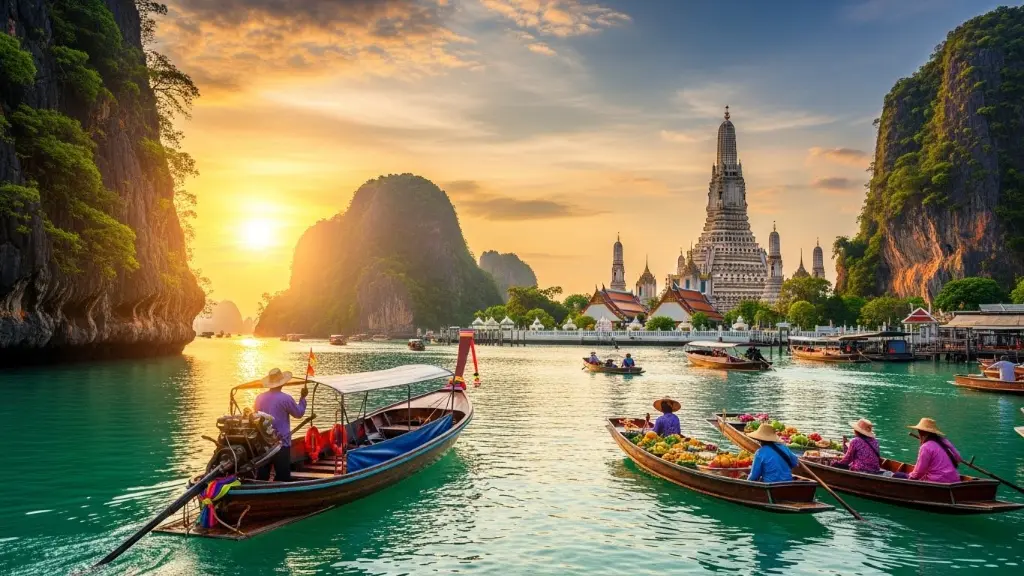
Imagine a land where the gleaming gold of an ancient temple spire pierces a skyline of futuristic towers. Hear the gentle, melodic chant of saffron-robed monks mingling with the electric buzz of a tuk-tuk navigating a bustling street. Breathe in the intoxicating aroma of chili, lemongrass, and lime from a street-side food stall. This is the sensory symphony of the Kingdom of Thailand, a nation that dances with graceful ease between the ancient and the hyper-modern.
Known to the world as the “Land of Smiles,” Thailand’s welcoming spirit is legendary. But behind that warm smile lies a culture of incredible depth, complexity, and resilience. It is a kingdom forged by powerful dynasties, guided by the serene wisdom of Buddhism, and flavored with a philosophy of life that prioritizes joy and harmony.
This article is your invitation to journey beyond the postcard-perfect beaches. We will explore the sacred pillars of Thai identity: its deeply revered monarchy, its all-encompassing Buddhist faith, and the unique cultural tapestry that governs everything from a simple greeting to the art of a perfectly balanced meal. Prepare to discover a kingdom that has mastered the art of being both timeless and ceaselessly new.
👑 The Enduring Crown: A Kingdom Defined by its Monarchy
To understand Thailand, you must first understand the central and sacred role of the King. The monarchy is not just a political institution; it is the spiritual and cultural heart of the nation, a symbol of unity and a source of immense reverence. The very concept of “Thai-ness” is inextricably linked to the crown.
See also Traditional Clothing Decline: Why Our Heritage Is Vanishing
A History Forged by Kings: From Sukhothai to Chakri
The story of the Thai nation is a grand epic of successive kingdoms, each leaving its indelible mark on the land and its people. This history is not just a collection of dates; it is a revered narrative of national development under the guidance of visionary kings.
| Kingdom | Period | Significance & Key Contributions |
|---|---|---|
| Sukhothai | 13th-15th Century | Considered the “dawn of happiness” and the cradle of Thai civilization. King Ramkhamhaeng is credited with creating the Thai alphabet. A golden age of art and Theravada Buddhism. |
| Ayutthaya | 14th-18th Century | A cosmopolitan powerhouse of global trade. Ayutthaya was a magnificent island city, its wealth attracting merchants from Europe, Persia, and China. Its dramatic fall to the Burmese in 1767 is a pivotal, tragic moment in Thai history. |
| Thonburi | 1767-1782 | A brief but crucial period where King Taksin the Great reunified the shattered kingdom after the fall of Ayutthaya, laying the groundwork for the modern nation. |
| Rattanakosin | 1782-Present | The current era, founded by King Rama I who established Bangkok as the capital. This is the era of the reigning Chakri Dynasty. |
This lineage of kings provides a powerful, unbroken thread of history. Thais learn from a young age to see their nation’s story through the achievements of its monarchs, who are portrayed as protectors of the faith and fathers of the people.
The Modern Monarchy: Reverence and Lese-Majesté 🙏
The reverence for the monarchy reached its zenith during the 70-year reign of the late King Bhumibol Adulyadej (Rama IX), who passed away in 2016. He was seen by many Thais as the embodiment of a righteous Buddhist king (dharmaraja), a father figure who worked tirelessly for the development of his country through thousands of royal projects. His image is still omnipresent and deeply cherished.
This deep respect is enshrined in law. Thailand has some of the strictest Lese-Majesté laws in the world, which make it illegal to defame, insult, or threaten the king, queen, heir-apparent, or regent. For visitors, this is a crucial cultural point to understand:
See also Forgotten Fashion Revival: Unlock Timeless Style Secrets Now!
- The Thai currency (baht) contains the King’s image, so stepping on it or mistreating it is considered highly offensive.
- In cinemas, the Royal Anthem is played before every film, and audiences are expected to stand in respect.
- Criticism of the royal family is a serious taboo and a criminal offense.
This institution is the unwavering anchor of the nation, a symbol of stability and identity that commands a level of devotion almost unparalleled in the modern world.
🕉️ The Soul of the Nation: Theravada Buddhism in Daily Life
If the monarchy is the head of Thailand, then Buddhism is its soul. Over 90% of the population practices Theravada Buddhism, and its principles and rituals permeate every aspect of daily life, from the way people interact to the very layout of the land.
Temples, Monks, and Merit: The Visual and Spiritual Landscape
Thailand’s landscape is dotted with over 40,000 temples, or wats. These are not just places of worship; they are the vibrant heart of community life, serving as schools, festivals grounds, and social centers. The sight of monks in their striking saffron robes walking silently on their morning alms round is a timeless and beautiful daily ritual.
A central concept in Thai Buddhism is merit-making (tam bun). Thais believe that performing good deeds—such as giving food to monks, donating to a temple, or even releasing a caged bird—creates positive karma that will lead to a better life now and in future rebirths. This philosophy fosters a culture of generosity and kindness that is palpable to any visitor.
Animism and Harmony: The Spirit Houses 👻
One of the most fascinating aspects of Thai spirituality is its beautiful syncretism. Theravada Buddhism is gracefully interwoven with much older animist beliefs. Thais believe the land is inhabited by spirits (phi), and it’s important to keep them happy.
This is most visible in the ubiquitous spirit houses (san phra phum). These miniature, ornate temples, mounted on a pedestal, can be found in front of almost every home, office building, and shopping mall. They are offerings of shelter to the guardian spirits of the land. Every day, people leave offerings of food, drink (often red Fanta!), and incense to placate these spirits and ensure good fortune and protection. It is a perfect example of how Thais harmonize different belief systems into a single, cohesive worldview.
✨ The Art of Living: The Grace and Fire of Thai Culture
Beyond the grand institutions of monarchy and religion lies the subtle, intricate “art of living” that truly defines the Thai character. It is a culture built on respect, a search for joy, and a philosophy of graceful acceptance.
The Language of Respect: The Wai and the Concept of Face 🙏
The most immediate cultural expression a visitor will encounter is the wai. It is a graceful gesture where the hands are placed together in a prayer-like position. The wai is so much more than a “hello.” It is a sign of respect, an apology, a thank you, and a farewell. The height of the hands and the depth of the bow indicate the level of respect being shown:
- Peers: Hands at chest level.
- Elders or Superiors: Hands at chin or nose level.
- Monks or Royalty: Hands at forehead level, often accompanied by a deeper bow.
The wai is connected to the deeply ingrained cultural concept of “saving face.” Direct confrontation and public criticism are strongly avoided. Maintaining social harmony, politeness, and avoiding embarrassment (for oneself and for others) is paramount. This contributes to the gentle, non-confrontational nature that is often characteristic of Thai interactions.
Sanuk, Sabai, and Mai Pen Rai: The Philosophy of Thai Life 😊
To understand the “Land of Smiles,” you need to know three magic words:
- Sanuk (สนุก): This means fun, joy, and a sense of playfulness. Thais believe that whatever you do, it should have an element of sanuk. Work, social gatherings, and even religious festivals should be enjoyable. It is the pursuit of pleasure in the everyday.
- Sabai (สบาย): This translates to comfort, ease, and well-being. Sabai dee mai? (“Are you comfortable/well?”) is a common greeting. It reflects a desire for a life that is free from stress and complication, both physically and emotionally.
- Mai Pen Rai (ไม่เป็นไร): This powerful and ubiquitous phrase means “it’s okay,” “don’t worry about it,” or “no problem.” It reflects a philosophy of letting go of small annoyances, of accepting things that cannot be changed, and of moving on with a light heart. It is the audible expression of a culture that values emotional equilibrium.
A Feast for the Senses: The Four Pillars of Thai Cuisine 🌶️🍜
Thai cuisine is a global phenomenon, and for good reason. It is a masterful balancing act, a culinary masterpiece where every dish seeks to harmonize the four fundamental flavor pillars: spicy, sour, salty, and sweet.
A meal is a communal affair, with multiple dishes served family-style. Key dishes that showcase this balance include:
- Tom Yum Goong: A hot and sour shrimp soup, brilliantly combining the spice of chilies, the sourness of lime, the saltiness of fish sauce, and a touch of sweetness.
- Pad Thai: The famous stir-fried noodle dish, where tamarind provides the sour, fish sauce the salt, palm sugar the sweet, and chili flakes the spice.
- Green Curry (Gaeng Keow Wan): A creamy, spicy curry made with coconut milk, green chilies, and Thai basil.
Thai food is not just nourishment; it is an experience, a celebration of flavor, and a central part of every social gathering.
The Art of Eight Limbs: Muay Thai 🥊
In stark contrast to the gentle wai is the fierce and powerful art of Muay Thai. Known as the “Art of Eight Limbs,” this ancient martial art utilizes fists, elbows, knees, and shins, making it one of the most effective striking disciplines in the world.
But Muay Thai is more than just a combat sport. It is deeply spiritual. Fighters perform a pre-fight ritual dance called the Wai Khru Ram Muay to show respect to their teachers, their parents, and their country. The fighter wears a sacred headband (mongkhon) during this ritual, which is believed to offer protection and good fortune. It is a perfect embodiment of the Thai spirit: a combination of fierce power and deep-seated spiritual respect.
🛡️ The Land of Freedom: Navigating a Complex World
One of the greatest points of national pride for Thailand is that it is the only country in Southeast Asia that was never formally colonized by a European power. The very name of the country, Prathet Thai (ประเทศไทย), means “Land of the Free.”
During the 19th century, when Britain and France were carving up the region, the Kingdom of Siam (as it was then known) found itself in a precarious position. The brilliant diplomatic maneuvering of two successive kings, King Mongkut (Rama IV) and his son King Chulalongkorn (Rama V), saved the kingdom.
They did this by:
- Modernizing the country along Western lines to be seen as a “civilized” nation.
- Willingly ceding small amounts of territory to Britain (in modern-day Malaysia) and France (in modern-day Laos and Cambodia) to appease their ambitions.
- Positioning Siam as a useful and necessary buffer state between the British and French empires.
This legacy of diplomatic skill and fierce independence is a cornerstone of the modern Thai identity.
Conclusion: A Kingdom of Graceful Contradictions
The Kingdom of Thailand is a land of beautiful and harmonious contradictions. It is a place where ancient animist spirit houses stand in the shadow of gleaming skyscrapers, where the serene grace of the wai coexists with the explosive power of Muay Thai, and where a deep reverence for an ancient monarchy provides the foundation for a dynamic, modern economy.
To visit Thailand is to be immersed in a culture that has perfected the balance between tradition and change, between spiritual devotion and a joyful embrace of life’s simple pleasures (sanuk). The “Land of Smiles” is not a marketing slogan; it is the outward expression of a deep philosophy of life, one that prioritizes harmony, respect, and a light heart. It is a kingdom that welcomes the world with open arms, but never for a moment forgets the sacred history and unique identity that make it so truly special.
What aspect of Thai culture fascinates you the most—its monarchy, its food, its spiritual beliefs? Share your thoughts and questions in the comments below! 👇
❓ Frequently Asked Questions about the Kingdom of Thailand
Q1: What does the name “Thailand” mean?
A: “Thailand” translates to “Land of the Free.” This name was officially adopted in the 20th century to reflect the country’s unique history of never having been colonized by a European power, a great source of national pride.
Q2: Why is it considered disrespectful to touch someone’s head in Thailand?
A: In Thai culture, the head is considered the most sacred part of the body, as it is the highest. Conversely, the feet are considered the lowest and least clean part. Therefore, touching someone’s head is a significant sign of disrespect, while pointing your feet at someone or at a religious icon is also highly offensive.
Q3: Is it difficult for a tourist to navigate the Lese-Majesté laws?
A: Not at all, as long as you are respectful. The key is simply to avoid any negative comments about the Royal Family and to show respect when the Royal Anthem is played. For the average tourist, showing the same level of respect you would for any head of state is more than sufficient.
Q4: What is the best way to give a “wai”?
A: As a foreigner, you are not generally expected to initiate a wai, but it is a sign of great respect to return one. A simple rule is to mirror the wai you are given. A younger person or person of lower status will wai you first. When you return it, a simple press of the palms together at chest level is a polite and safe gesture that will be warmly appreciated.