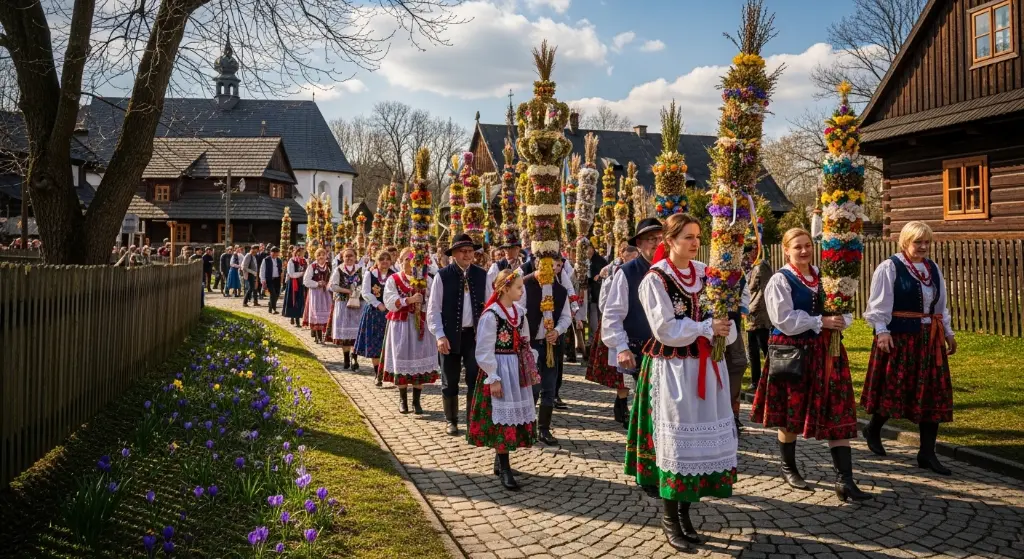
Imagine a burst of impossible color against the pale, hesitant sky of a Polish spring. Towers of intricate, rainbow-hued flowers, some reaching higher than the houses, are carefully raised towards the heavens. This is not a dream. This is Palm Sunday in the Kurpie region of Poland, and you are witnessing one of Europe’s most spectacular and beautiful folk traditions: the creation and celebration of the Kurpie Easter Palm (Palma Kurpiowska).
These are not the simple, green fronds you might see in other parts of the world. The Kurpie palm is a masterpiece of folk art, a testament to a community’s faith, a defiant bloom against the last vestiges of winter, and a storybook woven from paper, wood, and wildflowers. It is a tradition so unique and precious that it transforms a religious holiday into a breathtaking cultural spectacle.
This article invites you to journey into the heart of Poland’s “Green Forest,” the home of the Kurpie people. We will uncover the anatomy of these magnificent palms, learn the secret language of their flowers and colors, witness the communal joy of their creation, and understand why these towering works of art are a profound symbol of cultural identity and resilience.
🌳 The Land of the Green Forest: Who Are the Kurpie?
To understand the palm, you must first understand the people and the place. The Kurpie are an ethnographic group from a region in north-eastern Poland known as the Puszcza Zielona, or the Green Forest.
See also Noc Kupały: Poland’s Ancient Night of Fire, Water, and Magic
- A Forest People: Historically, this was a land of dense forests, marshlands, and sandy soils. The Kurpie were hunters, beekeepers, and amber gatherers, living in relative isolation for centuries. This isolation allowed them to develop and preserve a unique and powerful folk culture, rich in its own dialect, music, dances, and, of course, intricate handicrafts.
- A Deep Connection to Nature: Their lives were inextricably linked to the forest. They drew their resources, their livelihood, and their spiritual inspiration from the natural world around them. This deep reverence for nature is a key ingredient in every aspect of their art, especially the Easter palm.
The Kurpie culture is a beautiful blend of staunch Catholic faith and much older, pre-Christian beliefs tied to the cycles of nature, life, and magic. The Easter palm is where all these threads beautifully intertwine.
✨ Anatomy of a Masterpiece: What is a Kurpie Palm?
A Kurpie palm is an object of astonishing complexity and beauty. It is defined by its towering height, its vibrant colors, and, most importantly, the specific, sacred materials from which it is made.
Towers of Flowers: Size and Scale
The first thing that strikes you about a Kurpie palm is its size. While families will make smaller palms to carry to church and decorate their homes, the region is famous for the gigantic palms created for community competitions, most notably in the village of Łyse. These palms are true engineering marvels, often reaching heights of 20, 30, or even over 60 feet! Raising one of these giants into a vertical position on Palm Sunday is a tense and dramatic community effort, a delicate dance with gravity.
The Sacred Materials: A Palette from Nature and Paper 🌿
The most important rule in creating an authentic Kurpie palm is that it must not contain any fresh, living flowers. This is not an aesthetic choice; it is a deep-seated tradition. The palm is meant to be a symbol of everlasting life and to last throughout the year, its protective powers enduring. Fresh flowers would wilt and die, contradicting this core symbolism.
See also The Magical Night of Polish Witches: Myths, Folklore, and Kupala Night
The components are therefore carefully chosen for their beauty and longevity:
| Component | Material & Description | Symbolism & Meaning |
|---|---|---|
| The Trunk (Drzewce) | A long, straight wooden pole, typically from a pine or spruce tree, stripped of its bark. | The central axis connecting the earth to the heavens; the Tree of Life. |
| The Base Wrapping | Woven with green elements like bilberry twigs, boxwood, and stiff grasses. | Represents the earth, the forest floor, and the evergreen promise of life through winter. |
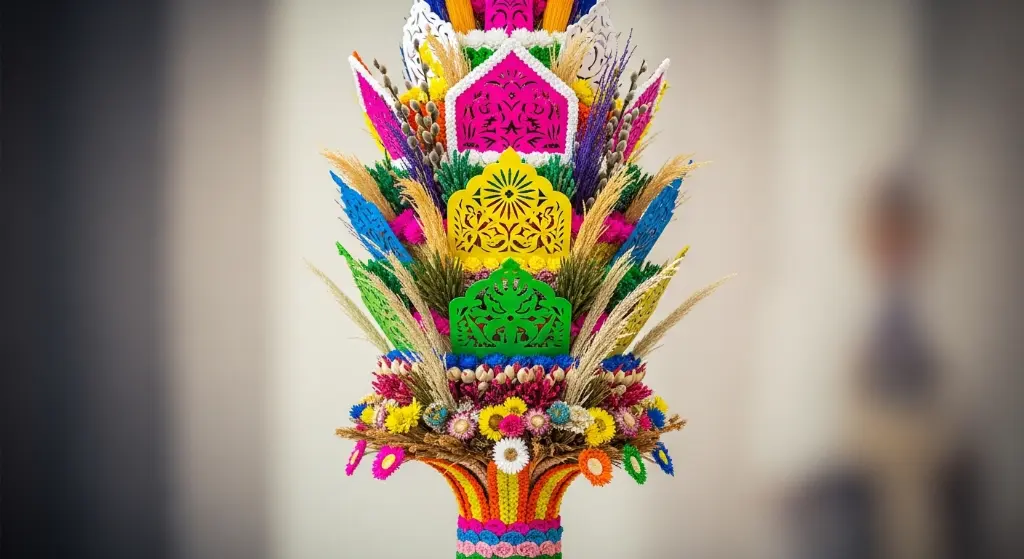
| The Flowers | Meticulously handmade from crepe paper (bibuła). This is the heart of the palm’s artistry. | The vibrant, joyful blossoming of life and the beauty of creation. They are “eternal” flowers that do not fade. |
| The Crown (Czub) | The very top, made of dried grasses, colorful ribbons, and often a prominent plume of foxtail or pampas grass. | Represents the sun, divine light, and the final burst of celestial glory. |
| Juniper & Willow | Sprigs of juniper and pussy willow are often incorporated into the base or woven throughout. | Juniper: A powerful protective plant, believed to ward off evil and sickness. Willow: In Polish tradition, the pussy willow (bazie) is the first tree to show signs of life in spring, a potent symbol of resurrection and vitality. |
The Language of Flowers and Colors
Every flower on a Kurpie palm is a small sculpture, handmade from colorful crepe paper. Women and girls spend weeks, even months, creating hundreds of these flowers. The colors are not random; they are a joyful explosion meant to celebrate the victory of life over the darkness of winter and the resurrection of Christ. Bright pinks, sunny yellows, deep purples, and vibrant blues all contribute to the palm’s “rainbow spear” appearance.
👩🎨 The Art of Creation: A Community Weaving Tradition
A Kurpie palm is not a commercial product; it is a creation born of community, patience, and skill passed down through generations.
A Year-Long Process
The creation of a great palm begins long before Easter.
- Summer & Autumn: Women and children forage in the forests and meadows, gathering specific types of grasses, mosses, and flowers to be dried for the crown.
- Winter: The long, dark winter evenings are the perfect time for the most painstaking work: creating the hundreds of paper flowers. This is often a communal activity, with grandmothers, mothers, and daughters sitting together, their hands a blur of motion as they cut, twist, and shape the delicate bibuła.
- Early Spring: The men select and prepare the long wooden pole that will serve as the palm’s spine.
- The Final Days: In the week before Palm Sunday, the final assembly begins. This is a collaborative effort, with the whole family or even neighbors working together to bind the flowers and greenery to the pole, starting from the base and working their way up to the magnificent crown.
As one artisan from the Kurpie region might say, “Each flower holds a thought, a prayer. When you see the whole palm, you are seeing the collected heart of a family for the whole year.”
🎉 Palm Sunday in Łyse: The Grand Celebration
The culmination of all this work is Palm Sunday (Niedziela Palmowa). While celebrated across Poland, the event in the village of Łyse is the most famous. It is a spectacle of faith, art, and community spirit.
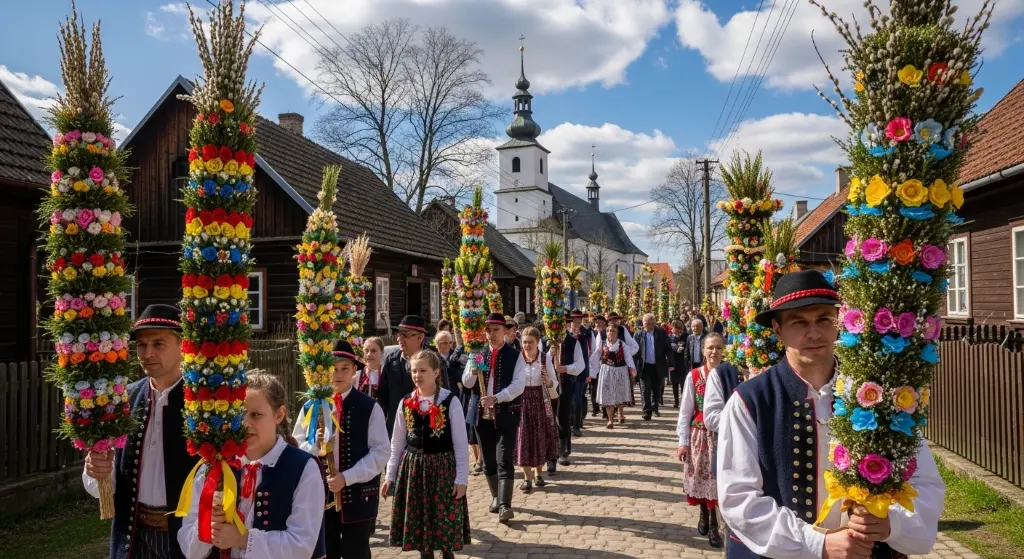
- The Procession of Giants: The day begins with a procession to the church. Families and community groups carry their magnificent palms, the smaller ones held aloft, the giants carried horizontally by teams of strong men. The town square transforms into a temporary, man-made forest of dazzling color.
- The Competition: A formal competition is held to judge the palms. They are judged not just on height, but on the traditional accuracy of the materials, the density and beauty of the flowers, and the overall artistry. Winning is a matter of immense local pride.
- The Blessing and Beyond: During the mass, the palms are blessed by the priest. This blessing imbues the palm with sacred, protective power. After the celebration, the palm is taken home and dismantled. Its components are used throughout the year:
- Blessed pussy willow branches are sometimes swallowed to ensure good health and prevent throat ailments.
- Small crosses made from the palm’s branches are stuck into the fields to ensure a good harvest.
- Pieces are placed in the home, often behind a holy picture, to protect the house from lightning, fire, and evil spirits.
- Some parts might be fed to livestock to keep them healthy.
The palm is not just an object to be admired; it is a vessel of sacred power that protects and blesses the community for the entire year to come.
🌱 From Decline to Revival: The Palm in the Modern World
Like many folk traditions, the art of the Kurpie palm faced a period of decline in the mid-20th century due to industrialization and social change. However, the tradition has experienced a powerful revival.
The annual competition in Łyse, which began in the 1960s, has been instrumental in this. It created a focal point, a reason to keep the craft alive and to strive for excellence. Today, the event attracts tourists from all over the world, bringing economic benefits and a global spotlight to this unique art form. Young people are learning the craft from their elders, ensuring that the skills are not lost. The Kurpie palm has become a powerful symbol of the region’s identity and its cultural resilience, a testament to a community’s determination to keep its unique heritage vibrant and alive.
Conclusion: A Defiant Bloom of Faith and Culture
The Kurpie Easter Palm is so much more than a festive decoration. It is a tower of faith, a chronicle of a year’s labor, and a vibrant encyclopedia of folk symbolism. It is a defiant bloom of color against the grey of winter, a joyful shout celebrating the resurrection of life, nature, and Christ.
In its towering form, we see the aspirations of a community reaching for the heavens. In its handmade flowers, we see the patient artistry passed from mother to daughter. And in its blessed branches, we see a deep-seated belief in a world where the sacred is woven into the very fabric of everyday life. The Kurpie palm is a profound and beautiful reminder that the most powerful traditions are those that a community holds together, raising them up for the entire world to see.
❓ Frequently Asked Questions about Kurpie Easter Palms
Q1: What is the tallest Kurpie palm ever made?
A: The records are broken frequently, but the tallest palms created for the Łyse competition have exceeded 37 meters (over 120 feet)! These incredible structures require sophisticated engineering and a large team to raise safely.
Q2: Why are pussy willows used instead of real palm branches?
A: This is a beautiful example of cultural adaptation. Palm trees do not grow in Poland’s climate. The native pussy willow, with its soft catkins, is one of the very first plants to show signs of life after the long winter. It was therefore adopted as the natural local symbol of resurrection and new life, perfectly fitting the spirit of Palm Sunday.
Q3: Can tourists buy authentic Kurpie palms?
A: Yes. During the Easter season, local artisans in the Kurpie region sell palms of all sizes, from small ones to take home to more elaborate, medium-sized ones. Buying directly from these artists is the best way to support the continuation of this beautiful craft.
Q4: What other crafts is the Kurpie region known for?
A: The Kurpie people are renowned for a wide range of folk arts, including intricate paper cut-outs (wycinanki), traditional amber work, festive bread baking (byśki and nowe latko), and unique regional embroidery and costumes. The palms are just one jewel in a rich crown of cultural heritage.
References (APA Style):
- Czerwińska, A. (2018). The Kurpie Palm: Tradition and Art. Ethnographic Museum of Warsaw. (General reference, hypothetical publication for citation example).
- Polish Tourism Organisation. (n.d.). Palm Sunday in Łyse. Retrieved from [official Polish tourism websites].
- Various ethnographic articles and publications from the Museum of Kurpie Culture in Ostrołęka, Poland. (This is the primary academic source for this topic).